The Group Partners Strategic Toolkit
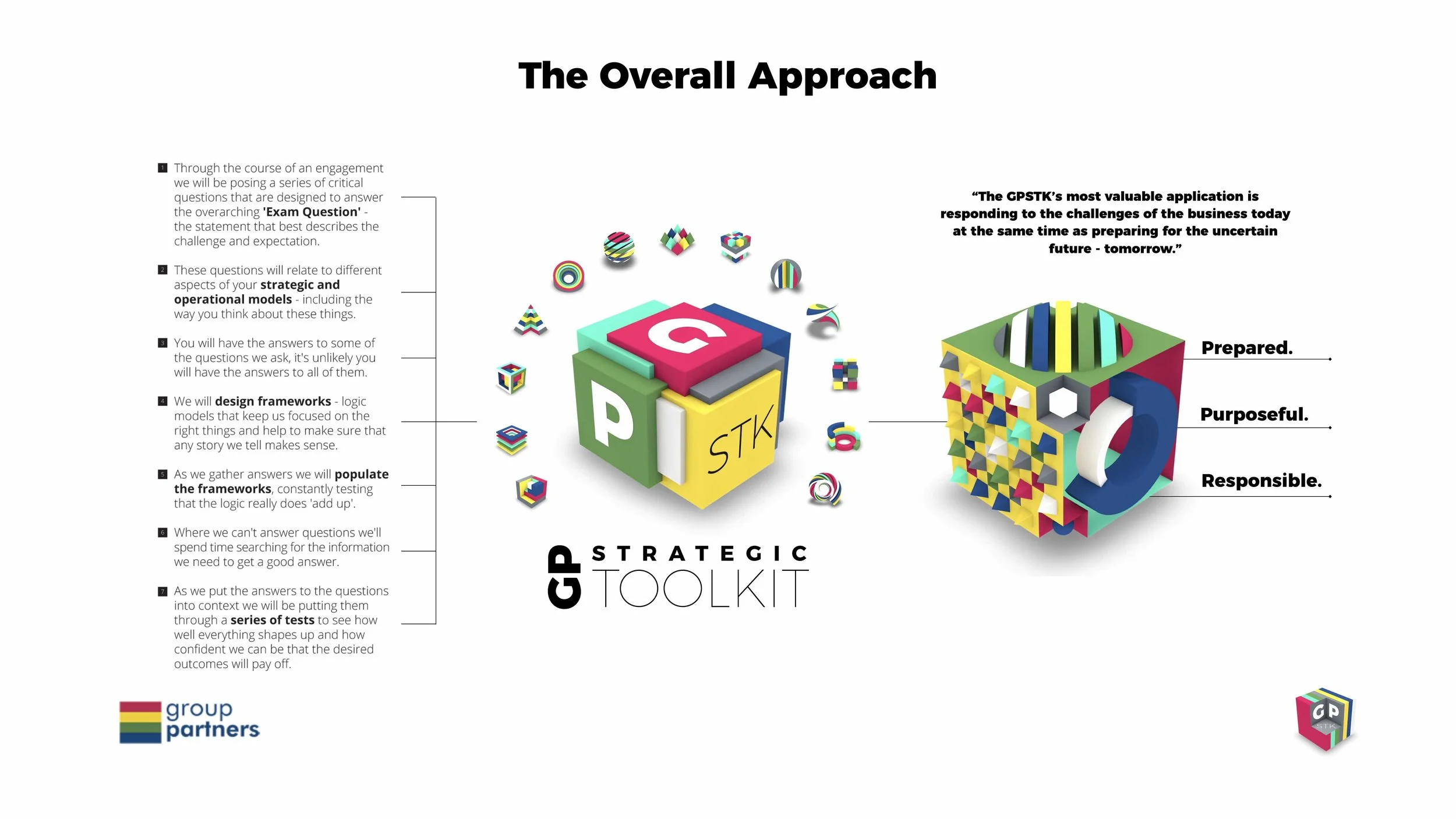
“The Strategic Toolkit’s most valuable application is responding to the challenges of the business today at the same time as preparing for the uncertain future - tomorrow.”
When To Use It
In all strategic contexts the GPSTK is the fastest route to tackling change, transformation, opportunity development and problem solving in the business. In short it can be applied whenever the leaders have to think critically about the future path for the business or to solve the challenges and opportunities it has
Why Use It
It’s a proven, comprehensive and high performing approach to critical thinking and execution for strategy of all types. The GPSTK is a response to the forces that conspire to make life complex. It’s main focus is to help teams unravel complexity and develop their strategic ambitions for the future.

A High Level Context
The world and business is complex. Far too complex for many leaders who are already stretched just keeping up. This is an increasing threat for leaders so we have designed the Toolkit to help clarify the means by which teams can work together with us to develop high performing plans for this new future.
The GPSTK is designed for today’s leadership and their teams. It’s the result of the thousands of cases we’ve worked on over the last 20 years.
It’s been created to cope with the practical pressures that exist in today’s business world. We understand that leaders operate with limited capacity, resource and budgets to allow them to think critically enough about the future and the very real challenges of today.
Collaborative And Creative
These days teams can be widely distributed - operating virtually - with pressures on all sides and with dynamic activity going on all around the world. We designed our approach with that in mind. Highly structured and visually symbolic it’s accessible and designed without ‘speak’.
It is a natural extension of Structured Visual Thinking our well proven methodology for problem solving and strategic development. We’ve designed the GPSTK to transcend the barriers of both spoken language and the technical experience required to manage the complex.
“The marriage of computing and connectivity without the shackles of being tethered to a location is one of the biggest disruptive forces of modern times.” - Om Malik
The Principles Of The Approach
Firstly - The Question Of Perspective
As a business leader you’ve developed a specific perspective on your business. That’s good. Everybody else in the business does too. That’s not always good - it’s where complexity strikes.
Everyone in your organisation has their own perspective. And they are entitled to it. The objective (for any effective and efficient strategic challenge) is to align around one unified way ahead.
Alignment is one of these wonderful (on paper) ideas that is almost impossible to achieve. Well literally anyway. It’s pursuit, while noble, needs to be realistic.
Forming Informed Opinions
Because we each have our own perspective we inadvertently create battle-lines. The ‘differences’ are both natural and real. They exist and can badly hamper the ambition of a high performing organisation.
They are also subjective and context based. That makes them neither right nor wrong - just in need of consideration.
“It is the mark of an educated mind to be able to entertain a thought without accepting it.” - Aristotle
It really doesn’t matter what the industry sector or what the aim of the strategy is (improve, transform, disrupt, enter new markets etc.) - these are all realities that need to be dealt with.

A Bigger Picture - A Better Vision
Everyone views the world differently.
It’s these differing perspectives that create or disrupt the organisation. Everyone and everything is part of the organisation. It’s important that it’s all reflected.
This representation shows the most apparent components for considering the future. And understanding them properly is vital to designing the correct strategy to get there.
Everyone in the organisation has important insights that contribute to this design. Their future performance and experience will be highly influenced by how the result works.
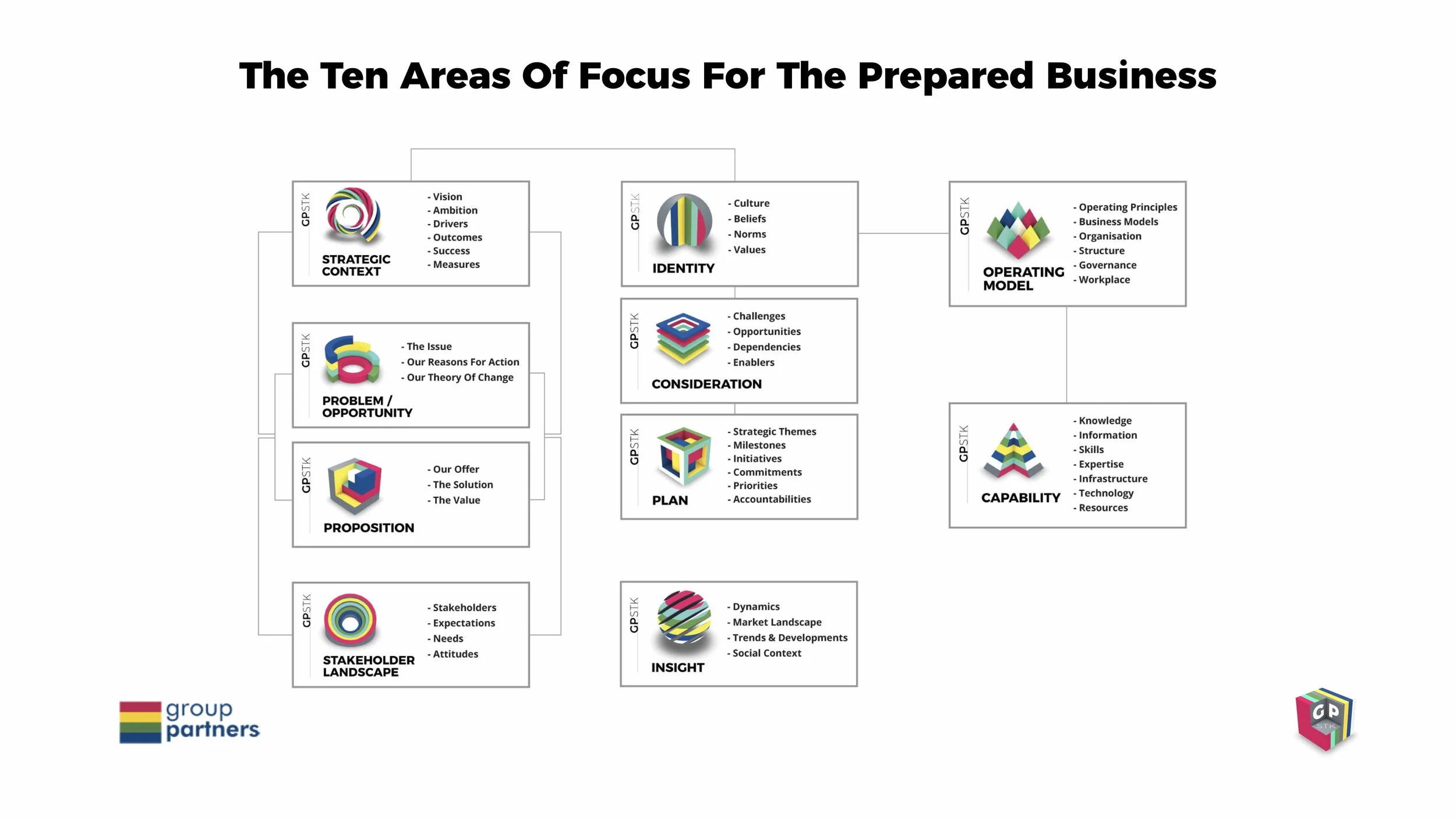
Whatever complex task or challenge we encounter we gather tools to help us perform it. Because it’s complex we will require a range of tools.
In any strategic challenge first base is always to understand the intention. Then the business has to figure out how to achieve it. That results in a lot of questions that will need answers.
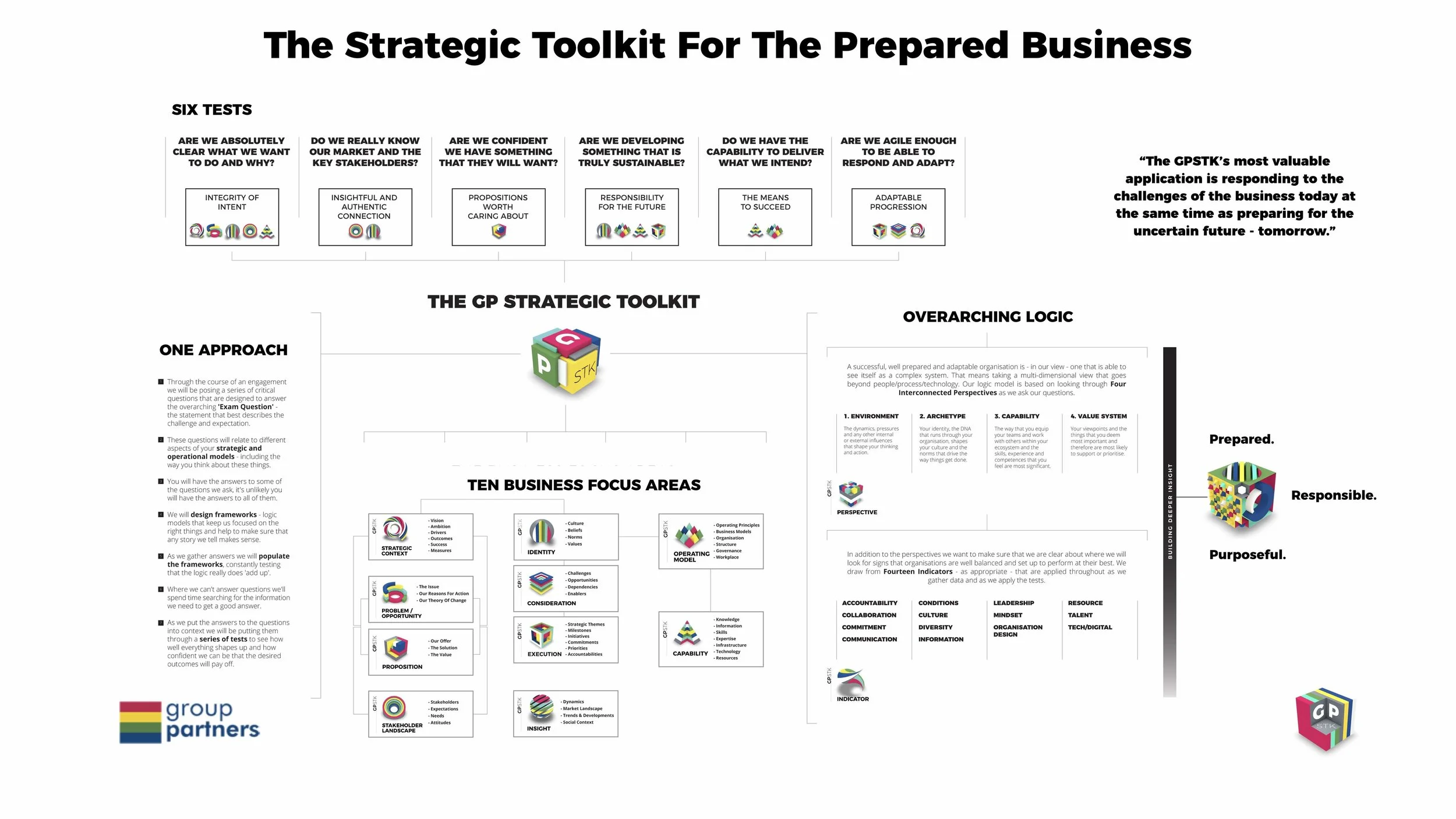
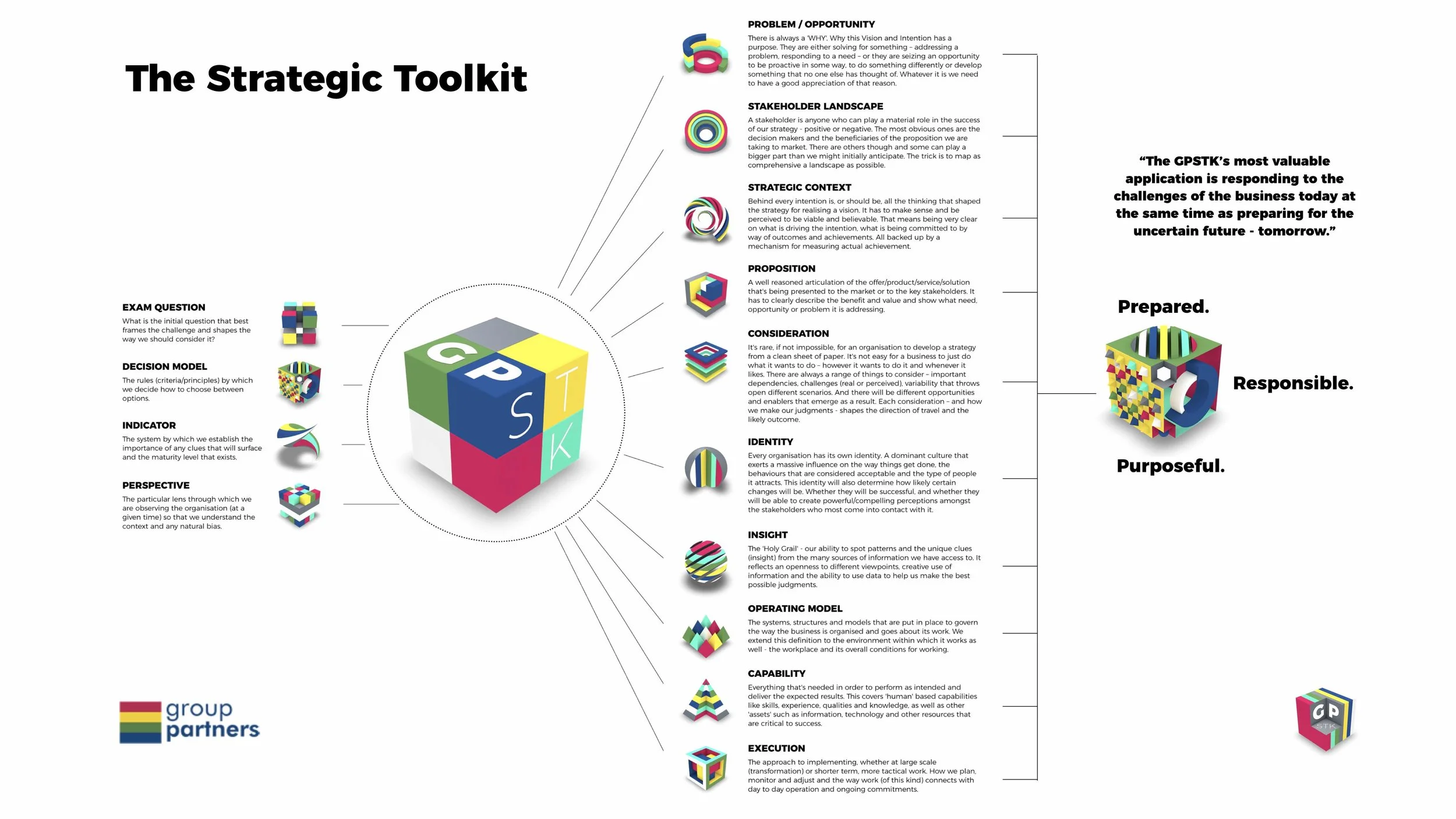
Define The Challenge - The first tool for that is the exam question. This is the highest order of question - it will need to express the whole challenge.
Test For Readiness - Having agreed the exam question we apply 6 tests. These give us a sense of the current state of the organisation. They will indicate the way the business currently thinks. Our aim is to gauge maturity*, attitude and readiness for the challenge.
Taking An Holistic View - We’ve determined 10 areas of business. They cover everything. They include the setting up of the strategy, the execution of the plans to deliver and everything involved in the day to day operation.
The Lifeblood & DNA - No business exists without the ‘organisation' upon which it rests. Our approach surfaces the insights we need to make it work fully. What can we learn through understanding the ‘Organisational Archetype’, its Value Systems, the reality behind its Capability and what are the Influences and Pressures it has to operate within.
*Maturity' is tested against 14 Indicators. Our measures signify different degrees dependent on business area and perspective. We are seeking the clues/signs that give us the indication of strengths and weaknesses against each test.
Think of all the things that an organisation needs to think about. Think of all the activities that are involved - that’s what we are concerned with. There’s a lot of things going on.
Our benchmarks for this covers 20 target areas. We know from experience how important it is to invest energy in getting these right. There’s so much that sits within these definitions. They inform the actions that become necessary to shape the organisation for the future.
Vision Shaping, Situational Awareness. Alignment, Placing Bets, Baselining, Building Intimacy, Establishing Relevance, Building Relationships, Building Market Relevance, Creating Attraction, Establishing Differentiation, Clarifying Responsibility, Making A Commitment, Considering Capability, Talent Attraction, Workplace Experience, Systems Designed for Purpose, Information Mastery, Establishing Line Of Sight, Maintaining Line Of Sight, Tracking Impact.

Bitter Experiences
We designed our approach from experience.
We start with the belief that everyone’s perspectives are both an opportunity and a challenge.
We test everything from a number of directions throughout every engagement.
We are always sensitive to the lack of bandwidth, broad experience, complex situations and opposing or legacy cultures.
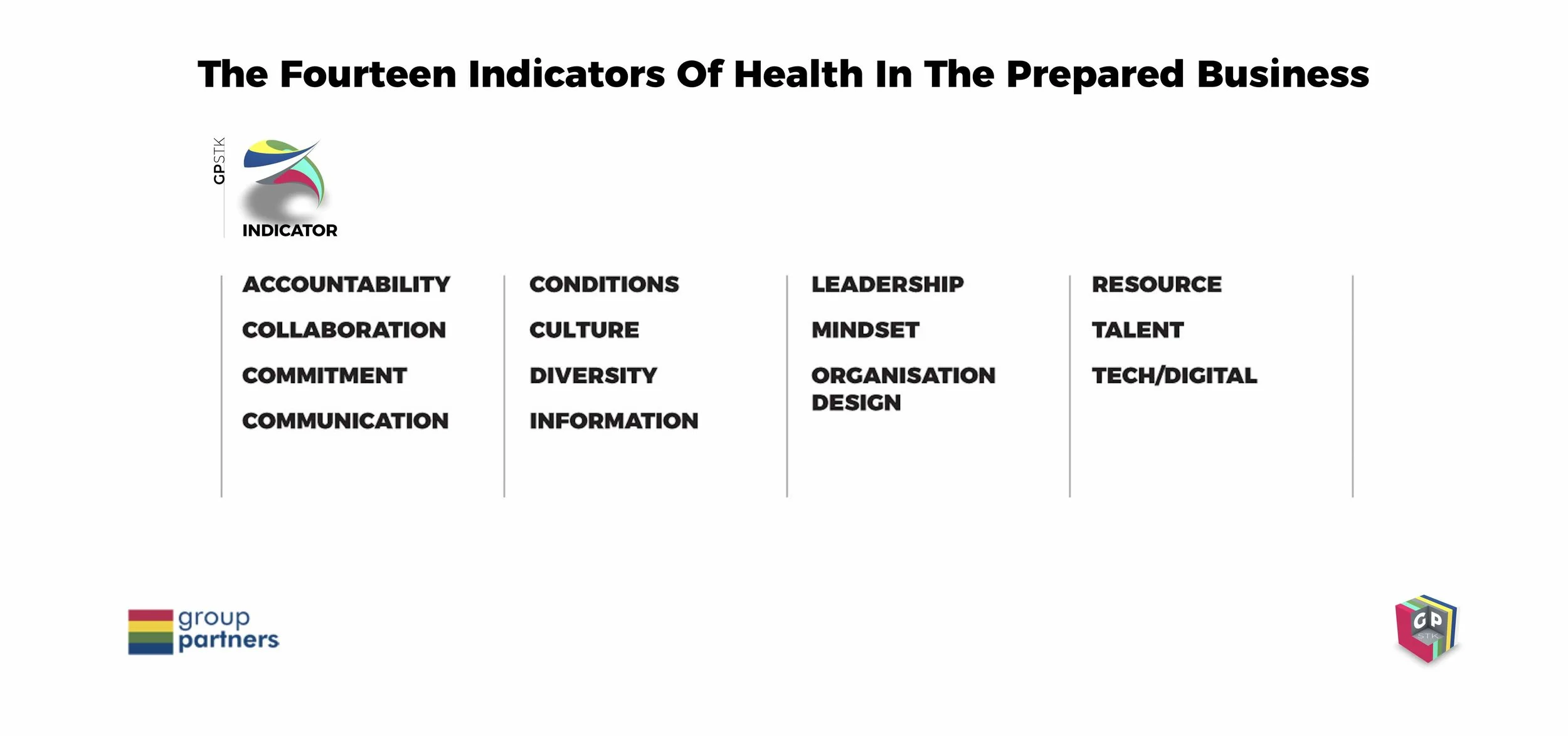
THE 14 INDICATORS
Clear Indications
Perspectives are real things, they exist. And there’s a wide spectrum of types. As with all terms they need some definition. At one end the more negative ones can be valuable because they hold clues as to why progress may be hard.
At the other the more positive are helpful because they lay out a powerful and optimistic viewpoint. The art is knowing how to translate them all and understand them appropriately.
As a consequence we turn them all to our advantage. The result informs the future strategy. No matter what happens through this approach, we will establish a broad appreciation of the opportunity or challenge at hand.
Over the years we’ve arrived at the set of Indicators. We use them to sense and score maturity and understanding. These indicators allow us to better appreciate every situation. We listen intently through every discussion. Each one is made up of subtle and nuanced conversations. We learn.
“Start where you are. Use what you have. Do what you can.” - Arthur Ashe
It important to apply multiple tests to get inside every aspect of the strategy. And it’s this testing and these indicators that deliver us the insights.
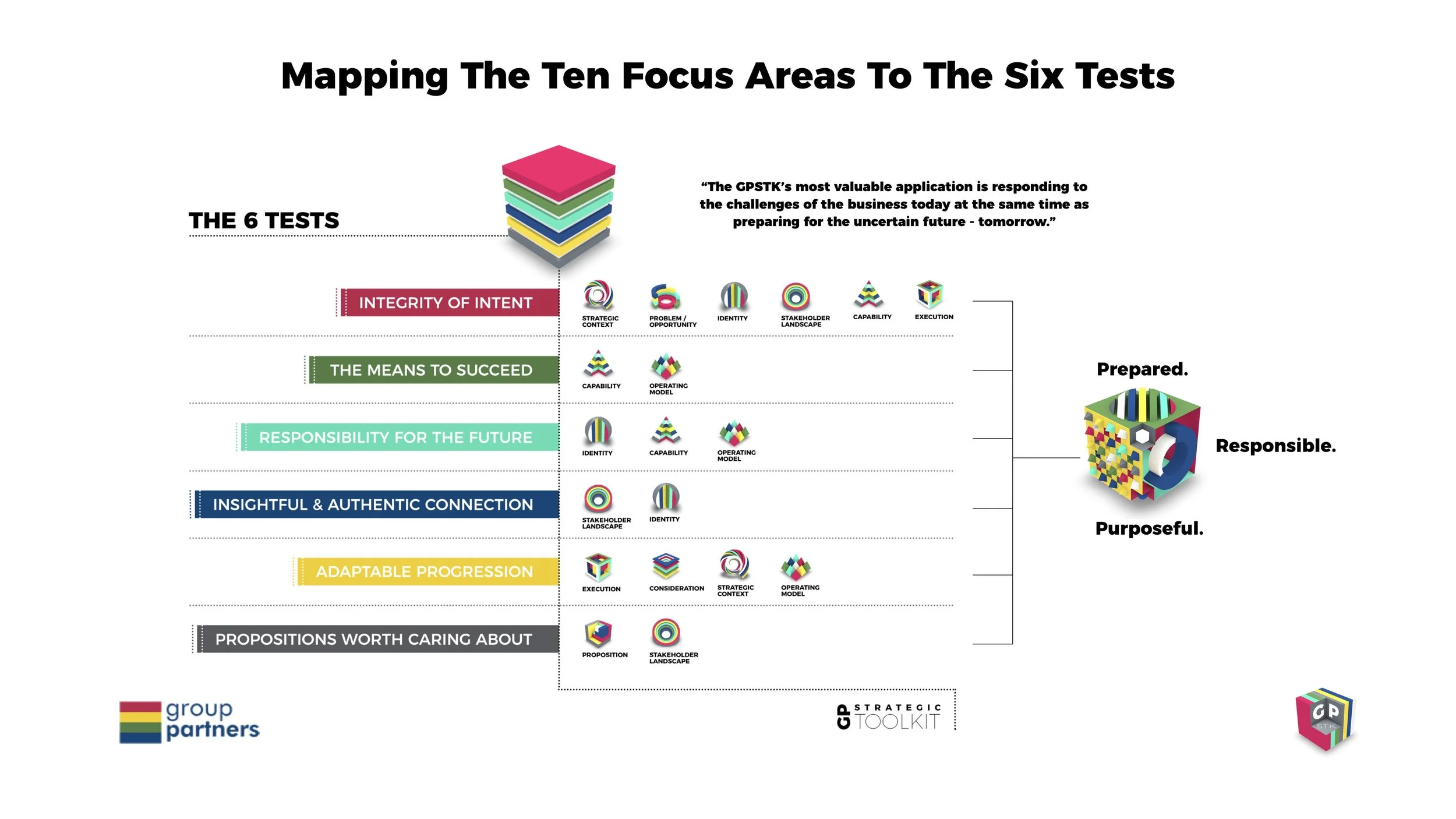
THE 6 TESTS
Tests, Examinations, Lenses and Filters
Spotting The Signs
While every organisation has its own personality and dynamics there is still a lot that every organisation has in common, things that are critical to the way it operates, the performance it achieves, the opportunities it does (or doesn’t) exploit and its long term prospects.
We Call These ‘Indicators’
There are 14 in total that we have chosen to focus on. Individually each Indicator represents a ‘hot spot’ - an important factor in the effectiveness and coherence of an Organisation.
When we start to position and study these Indicators in different contexts, and to group them in different ways, we start to get valuable insight into areas of tension, into strengths and degrees of alignment and into gaps and weaknesses. We see fragmentation and / or connectedness. We see contradictions and / or synergies.
There are 4 significant lenses through which we look at how an Organisation approaches these hot spots:
The influences and external factors
The organizational DNA
The values and attitudes within the Organisation
The utilization of resources at its disposal
We can assess all of this by asking a series of questions that between them look at 3 states that are important (to varying degrees) to every Organisation:
Preparedness - how well it is designed and equipped to cope with whatever the future may throw at it
Purposefulness - its clarity and strength or conviction in its mission
Responsibility - what it is prepared to be accountable for and the impact it wants to make

At this level we can get a pretty good sense of an organisations current states through a logic scan Using the indicators and the 4 lenses.
However, most organisations have an exam question to solve - maybe more than one.
They have a challenge, an opportunity, a mandate - and they want to get it right. They most likely have constraints that they have to work within. And a ton of pressures and commitment to juggle at the same time. This requires a deeper exploration that can't be addressed by scans alone. The best possible outcome depends on so many things coming together in the right way.
This calls for a more thorough examination
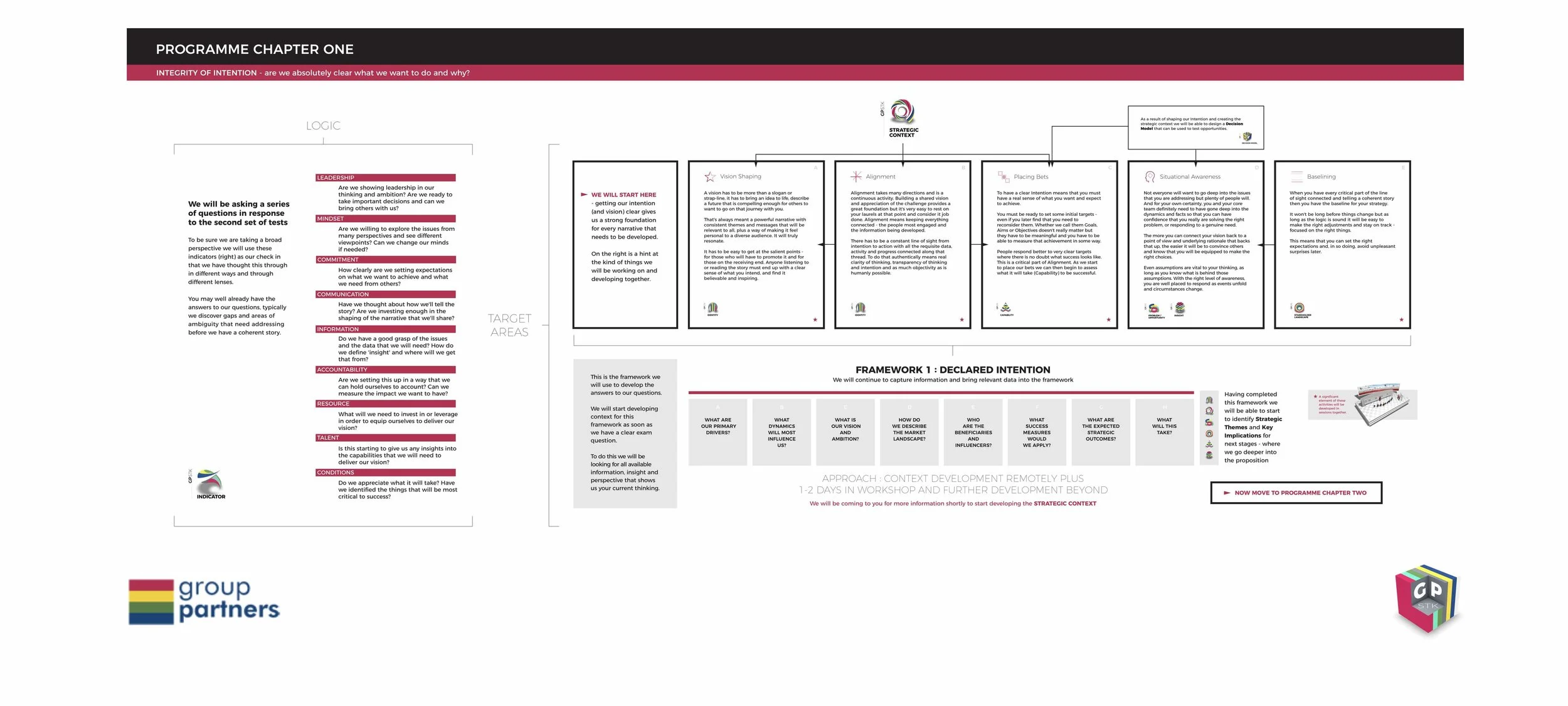
CHAPTER 1 - EXPLAINING WHAT WE NEED TO DEVELOP AND WHY WE NEED IT - WITH OUR CLIENTS
The best any of us can do is to think through our challenge as thoughtfully, as objectively, and as thoroughly as possible, to apply a logical ‘model’ to the way we make choices and to empower those with responsibility to give their best.
After that it's all about how we then execute on that and keep ourselves honest, how we handle changes and how we legitimize achievements.
We can put all of this through 6 tests:
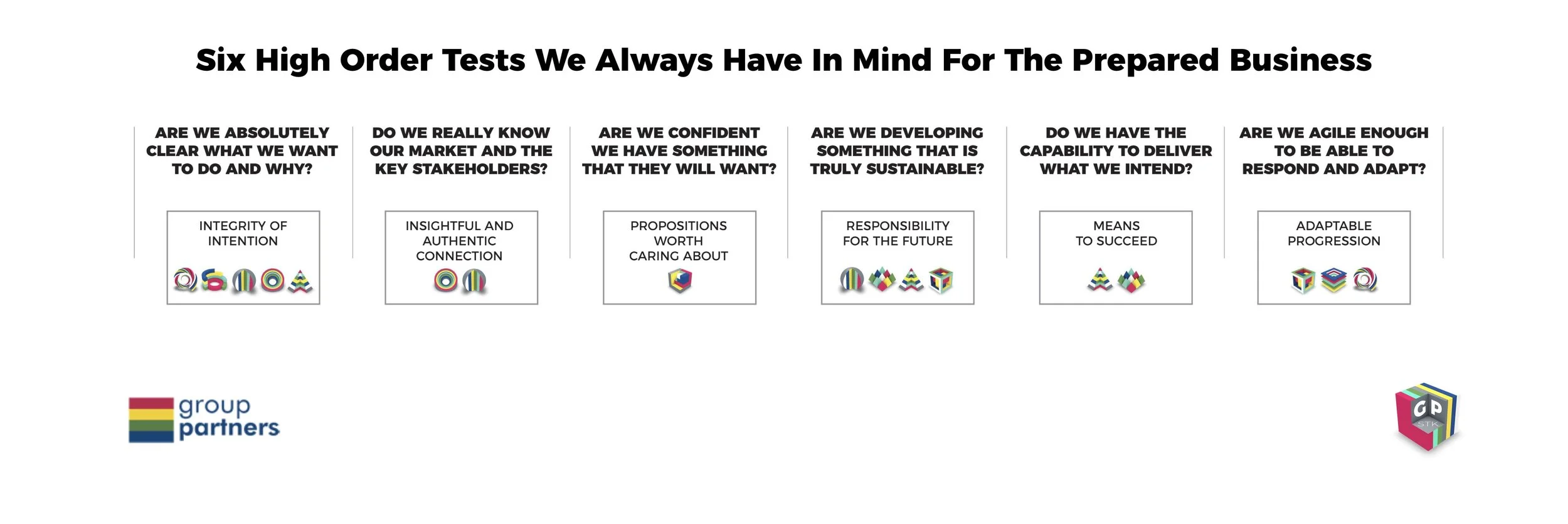
A Test of Intention (Integrity Of Intent)
A Test of Authenticity (Insightful & Authentic Connection)
A Test of Value (Propositions Worth Caring About)
A Test of Impact (Responsibility For The Future)
A Test of Viability (Means To Succeed)
A Test of Agility (Adaptable Progression)
At a high level it's possible to run a simple scan against each test for the Indicators that are most relevant. If you can answer each one with confidence then congratulations, you are looking good!
If - as for most organisations - some or all of the questions can't be easily or fully answered, or they highlight existing concerns then we can go deeper with more specific questions.
These tests will typically be a mix of online scanning, information gathering and group work. Running these tests requires real commitment and complete honesty.
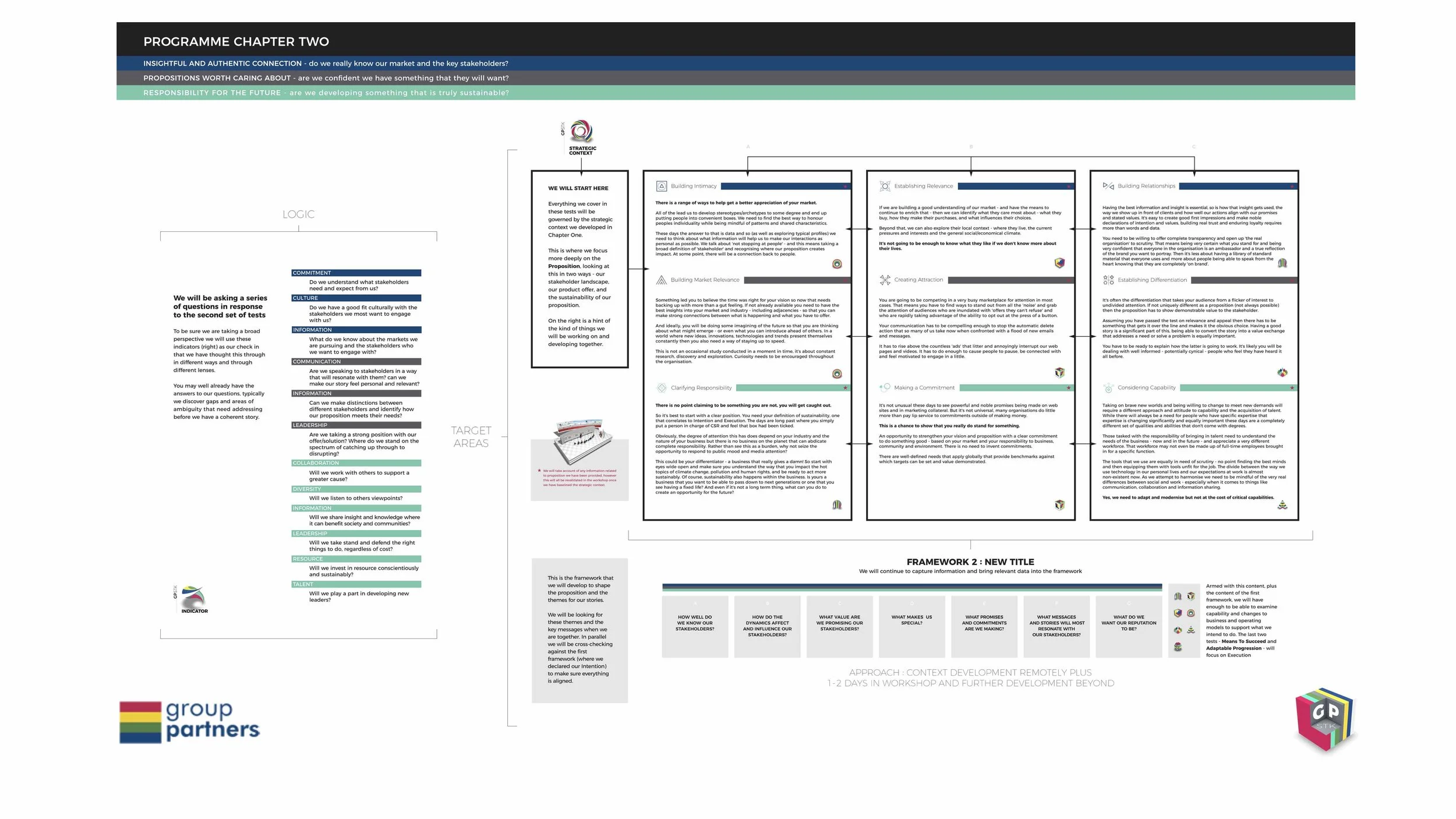
CHAPTER 2 - EXPLAINING WHAT WE NEED TO DEVELOP AND WHY WE NEED IT - WITH OUR CLIENTS
It can be pretty hard to put yourself through this level of rigour - to self examine and reach your own, completely objective assessment. But with a good framework, critical questions and a little bit of impartial observation and facilitation from outside the organisation you can get close.
This is not simply a survey that is going to put you into a certain ‘bucket’ or stereotype. This is the equivalent of an organisational MRI scan. As a result of this you will see your organisation differently, you will lose the fragmented viewpoints and break through silos.
The better the information we have to assess the greater the insight and the more accurate we can be in terms of where energy should be focused, where the constraints and risks are most visible and where opportunities need to be acted on.
When You Add It All Up
At a simple level -
We perform in depth tests. They allow us to validate (with sufficient rigour) the reality.
They get us into the detail that’s so important to a great outcome.
We compare and contrast the individual perspectives against the indicators.
We gather results from the tests that we apply.
We begin to see how the areas of the Strategic Toolkit should be applied - and in what sequence.
We can start to develop better answers to the stated exam question.