WELCOME
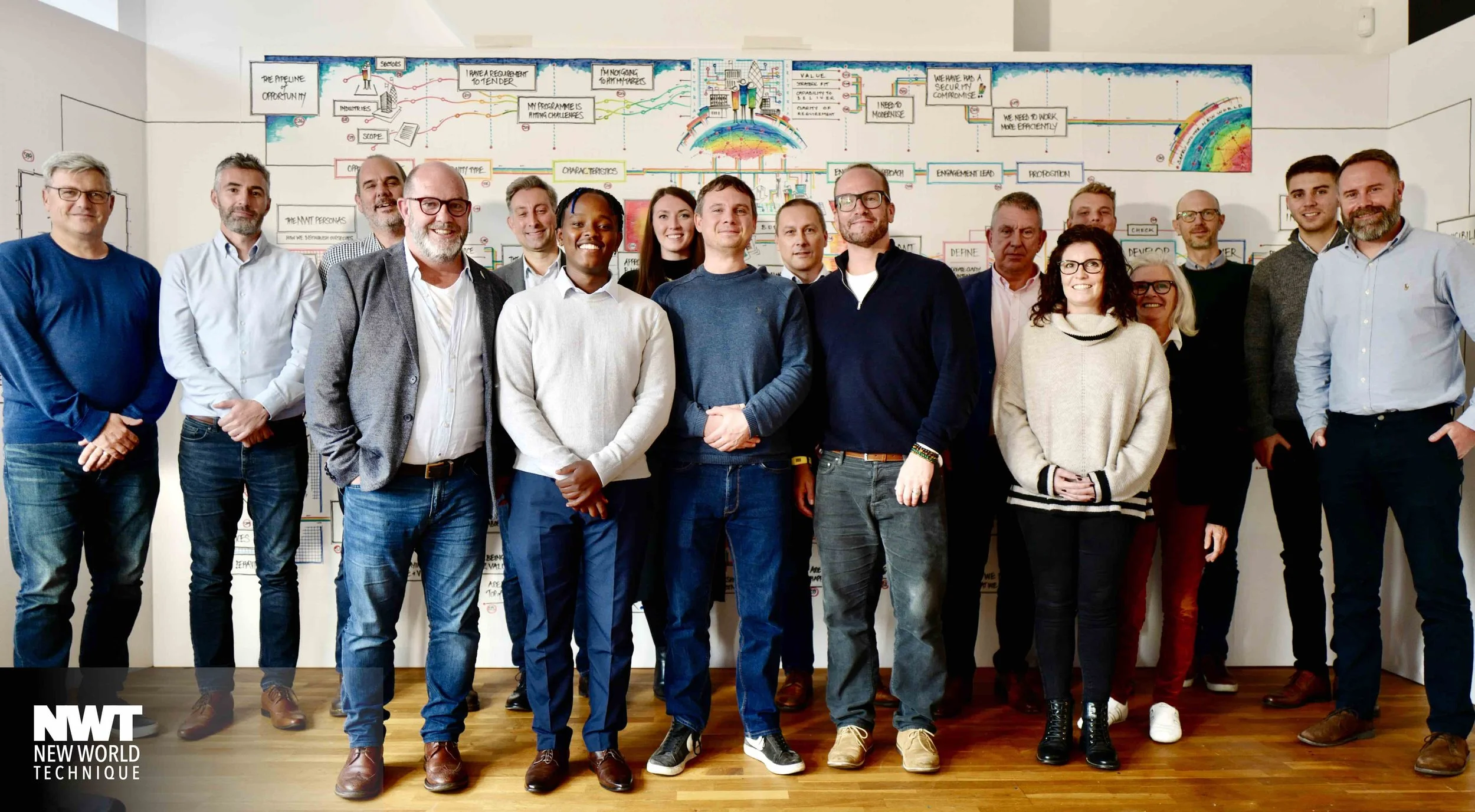
It was great to meet and work with you on the 5th and 6th.
We know it was an opportunity for some of you to meet for the first time and what a tribute to you and your values of inclusion and openness that you opened the session up to both newcomers and clients.
You will find access to the summarized narratives below. This is the result of your endeavours and our reflection. You will also have access to the images available for download in high and low resolution.

QUALITY TIME
Spending quality time with you as a team at a pivotal time of opportunity and growth was our focus. It was a great chance to consider the future and align the team on the best journey and path towards it.

THIS DOCUMENT
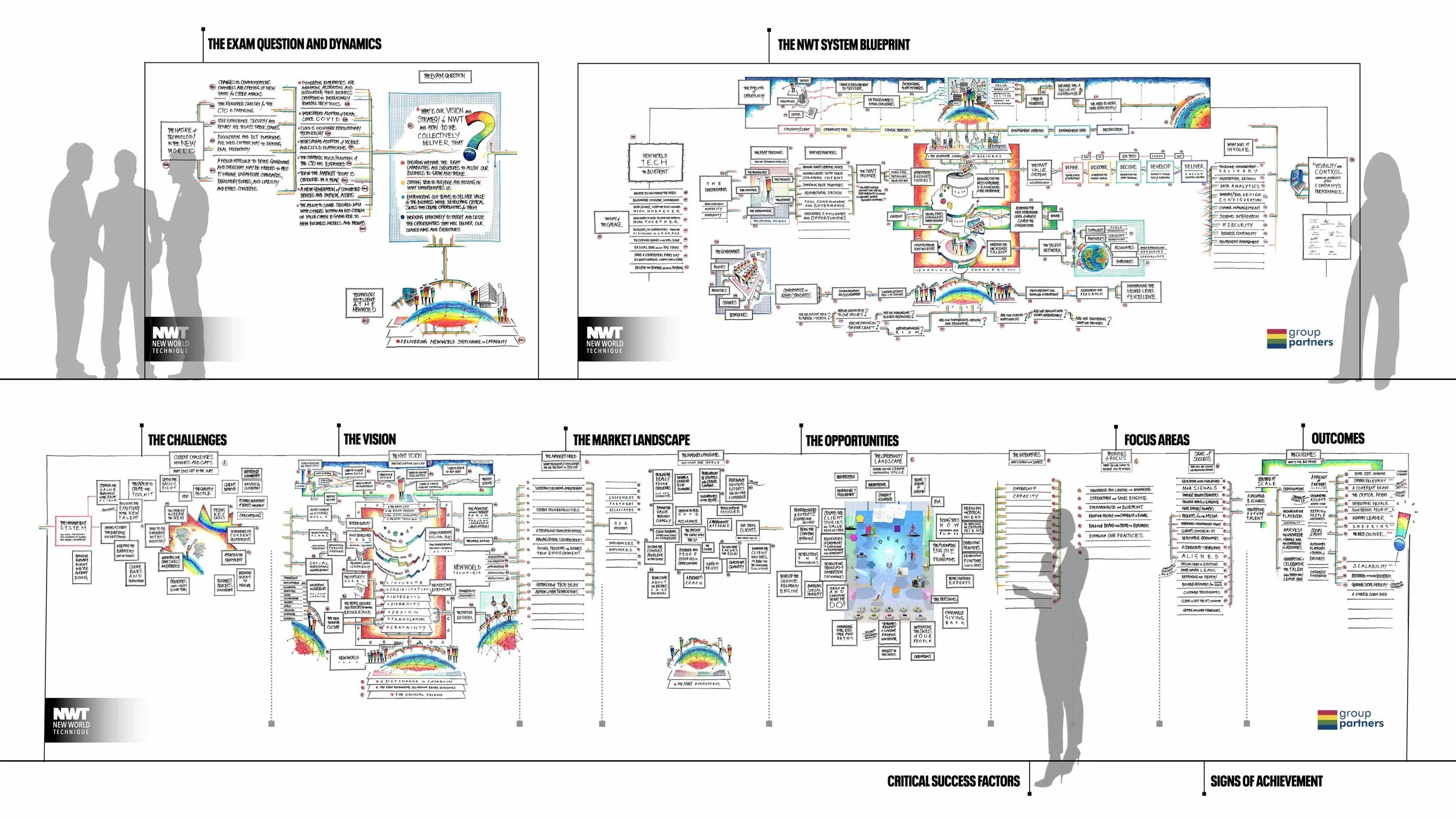
The following is split into three parts.
The first part explains the three frameworks and the overall approach—a simple reference to the structure of our conversations.
The second part associates the narratives with the images. It steps you through the summaries of each module. A synthesis of the main points gives you a quick reference to the day's discussions.
The third part explains the blueprint for collaborative innovation - designed purely as a hypothesis for the session.
https://framevr.io/svt-space

We Applied Structured Visual Thinking™
A straightforward strategic creative approach - digging in together on vital questions - capturing critical information through robust conversations to build the proper context within which to make crucial decisions and build winning strategies.
Our mantra is - let’s avoid solving the wrong problem really well.
THREE FRAMEWORKS
The first was the exam question. The question we felt was most valuable to tackle at this stage. Checking in on this first helped everybody get into the right frame of mind.
The second was the main ‘conversational framework’. A series of nine modules started to unpack the exam question over the two days.
The third framework was a hypothetical blueprint for collaborative innovation. Once it gets further developed, we feel it could help to establish a common approach to operations and the growth of NWT.
STRATEGIES ONLY WORK WHEN THEY’RE IMPLEMENTED
Preparation - We prepared as much as possible ahead of time to make the time together most effective. We brought forward information and context to stimulate conversation and help us think thoroughly about the opportunities ahead.
Frameworks - We design and develop frameworks because they force a logical and structured discussion. As they evolve, they build an interconnected context - ensuring the critical conversations needed to answer strategic challenges and leave the team with solid foundations.
Blueprints - Every successful enterprise has a blueprint. Call it a design, a system or a model. But for success, leaders need a mechanism that’s clear, aligned and owned by those whose futures rely on it. It must reflect the future ambition and define how the organization needs to operate to achieve it.

THE SPACE TO THINK
As everyone walked into the room, an element of preparatory material was already in place. This resulted from briefing calls, shared materials, our research and the gathering of context into the marketplace.
The Aim
The two days started the process of strategic alignment. A chance to come together, create shared meaning and appreciate implications—the two essential elements of any successful plan.
Meaning - We mean the definitions of everything. The big ideas, concepts, criteria, factors, needle movers, themes, outcomes, and scenarios. Without a shared understanding of these things, no strategy will survive execution.
Implications - Valid strategies are meaningful structures and systems. They have specific components, and leaders must appreciate the implication of each part on another. In times of change - implications are natural and felt across the organization as it shifts to support a new vision, purpose and strategy.
The Session Began
The 5th and 6th of October
“Our identity starts with people and our social values. Everyone was selected to be here - we are all part of this journey. It’s your chance to ad your input to the future of our buisness. We need each other.” - Glen Ballard
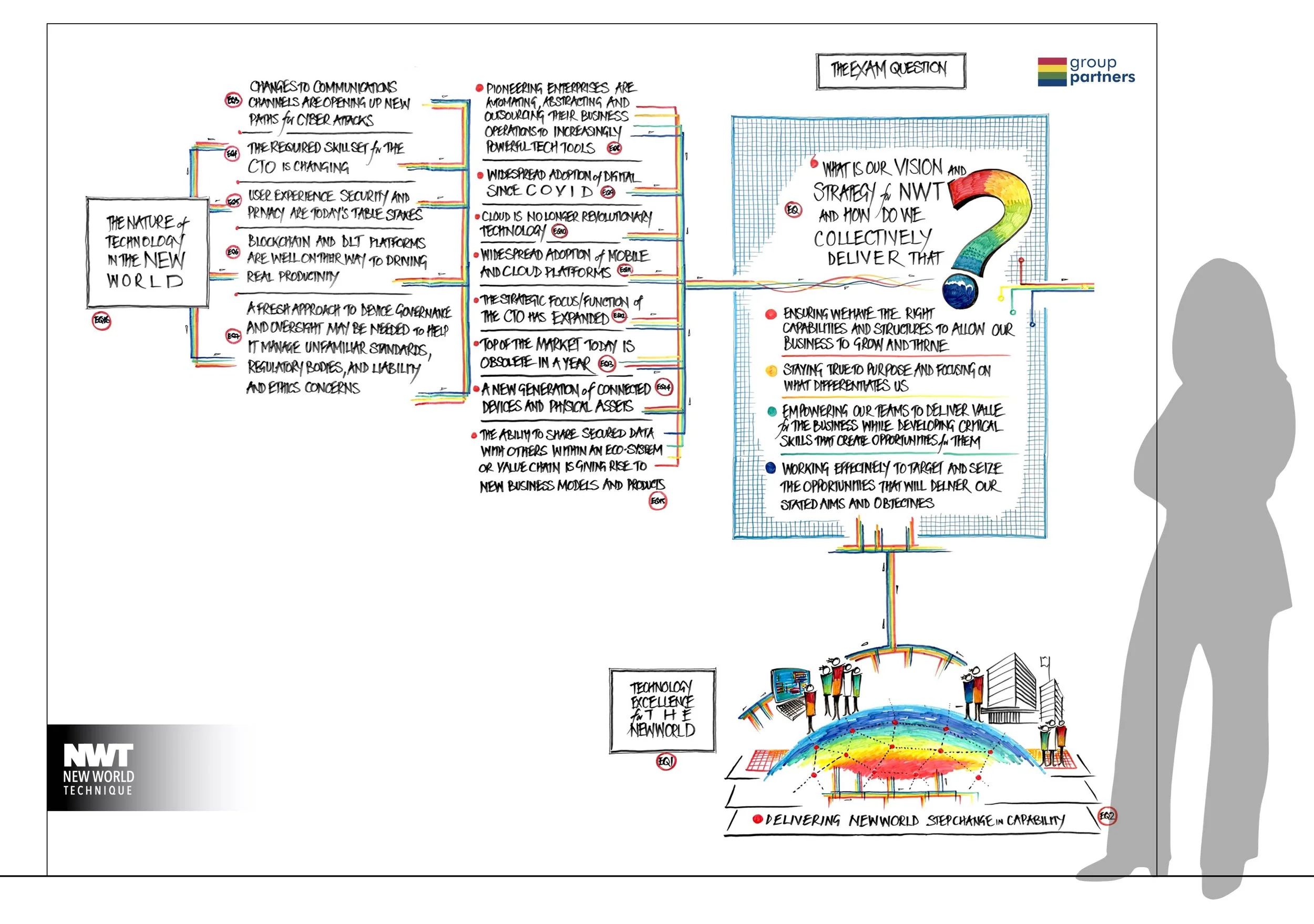
MODULE EQ - The Exam Question
What is our vision and strategy for NWT, and how do we collectively deliver that?
The Sub-Text:
Ensuring we have the right capabilities and structures to allow our business to grow and thrive
Staying true to purpose and focusing on what differentiates us
Empowering our teams to deliver value for the business while developing critical skills that create opportunities for the team
Working effectively to target and seize the opportunities that will deliver our stated aims and objectives.
The Discussion That Followed
The exam question is our chance to make sure we are all in the right context with a good apreciation of why we are spending such a lot of time dedicated to thinking about it.
We discussed our feelings about the question and what it evoked.
The challenge is how we answer this - it is the right question. We all have different areas of expertise, experience and aspirations. Bringing these perspectives together in a coherent way is critical. How do we break out of silos - when necessary - to ensure we bring our contributions together valuably? We don’t fully know what we have in our garage - we don’t currently do enough to share what we have.
When we look at the sheer scale of opportunity and the constantly changing landscape - we need to be clear about how we navigate this landscape and understand our markets and the dynamics. How do we create a roadmap of the right opportunities as we are ready to take them?
Very little work currently comes from fresh bids. Historically, it tends to be via connections and relationships. We haven’t had to be that good at building cases or constructing strong bid responses.
We must have clear, tangible goals and answer how we deliver them. We need to be clear about what we need to have an opinion about - and be sure it’s relevant and creates unique insight that we believe has value to our customers.
For example -
What do we think is changing about the CTO? The role tends to be informed by the scale and complexity of the business. There are different flavours of CTO. The definition used to be quite specific, but now there are many more definitions.
We now also have a number of different roles that blur the boundaries - CIO, CTO, and CDO. Every organisation may have these roles, but not all are defined similarly. Many of our customers are large enterprises and the CTO role there is relatively well known - this role is becoming more of a configurator than a designer these days. There is a much more significant data aspect to the role - and it ties the CTO to many other roles.
Post session note
As we progressed through the two days, the idea of the 12 big business problems became a central part of the vision. That means having solid points of view about the dynamics surrounding these problems - from our different perspectives - will help to increase the coherence of our propositions and the way we bring our contributions together.
We have agility as a team, and yet we are already feeling like we have heavyweight processes and policies in place - which will threaten our agility. It may not be the processes defined; it’s about how we integrate them into our business.
We have to automate more programmes and projects to be successful - we have to do to ourselves what we will offer to help clients. This is a change to our ‘model’ as we have traditionally been service and people-focused, which means the product is also becoming a part of our proposition.
We can only help clients to transform their operations if we can show real expertise in the tools we want to introduce and make solid cases for adoption. We don’t know fully what we have in our garage - we don’t currently do enough to share what we have.
There is a lot that we would love to do with our clients, but there are always constraints - appetite, budget, and scope. How we position ourselves to be able to do more of these things is an important factor - and that includes when we engage in the conversation and how proactive we can be in influencing scope. This needs to be done with an excellent contextual appreciation of the client’s position - we can’t be seen trying to (simply) be out to make more money.
We do a good job currently through the ‘critical friend’ model - which is pre-sales often and gives us a good starting point that we could strengthen through more rigour in supporting activities - like the creation of solid business cases. This role is the gateway to subsequent opportunities.
When we engage with the client, it’s often at a point where they face significant issues and challenges - we need empathy to know when to position further opportunities.
Being a critical friend is an influential role that demands we act with integrity. It requires us to have tough conversations sometimes, to remain true to our principles and the brand we are developing. We need to use this role internally as well - there will be times in our business when we want to draw on the expertise of our peers. That requires us to know what expertise and capability we have to draw on.
We want our legacy to be that we have enabled people to develop skills that will help them to shape their future. This is not just talking; it’s core to our vision.
MODULE I - The Outcomes
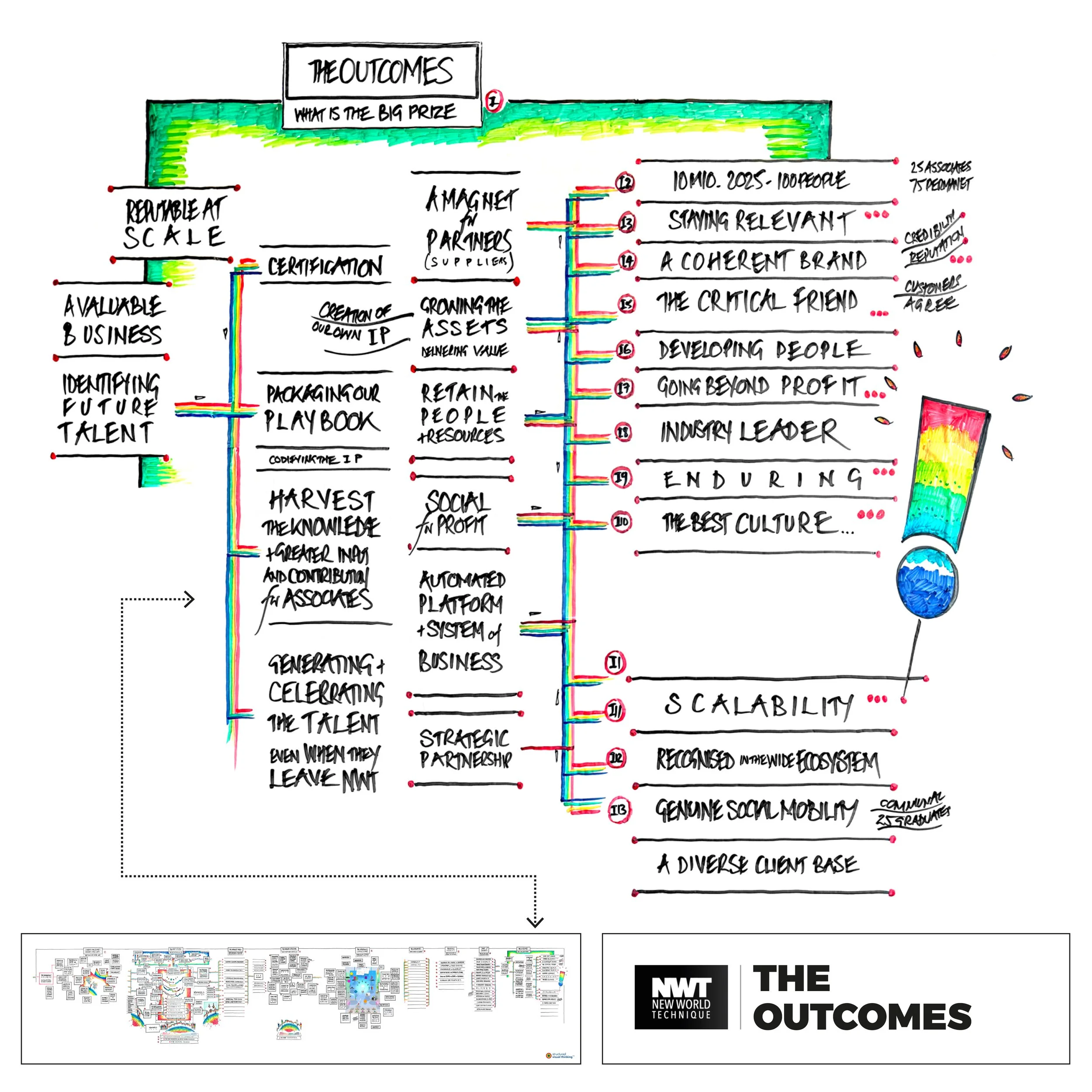
The Discussion That Followed
We started the strategic framework with beginning to define where we want to go and what is the big prize for us all. What is the result, our ambition, our outcome and end game - as least as far as we can imagine?
£10m by 2025 - 35% Gross profit - 100 people - 25 associates and 75 FTEs - and keeping our talent
Grow and remain a profitable and reputable business - which means growing ourselves internally. An enduring business that can be sustained beyond individuals. Our business is scalable.
We are at that tipping point. As we grow, we keep the culture that we are shaping now - it stays with us no matter how big we grow. It makes us a magnet for talent - we are a place people aspire to work. We have an authentic ‘bring yourself’ culture.
We are leveraging our full talent and skills. We know each other well - we know what skills we possess and the aspirations each person has for their development. Development can be staged in a meaningful way - there may be an element of dropping people in at the deep end, but there is a clear ‘ladder’ of progression to follow.
A business recognised for the creation of value and built on solid values. Clients buy outcomes from us because they trust us to help them with their challenges. We have a diverse client base coming to us differently and via different team members.
We are creating a diverse family of future generations of critical friends - bringing along the young and giving them opportunities we have enjoyed. And being known for this. We must be profitable to invest in the future and give others career opportunities. We will be the ones spotting the future talent and nurturing them on their journeys. Within this, we want to find 25 people who would not have had the opportunity without NWT. It is a deep commitment we have made.
We have an automated back office that requires minimal overhead and management.
We are building an asset-based company. Heavily underpinned by our people but also backed by rich insights that we can bring to clients. We are building our IP in critical areas - if we can define what equates to genuine NWT IP. We arguably create IP all the time, but we must ‘bottle’ that. Things like ‘how to approach a helpdesk migration’. We need to create these artefacts. Create our playbook. This will include pure technical IP - code, for example.
What we need to major in is the knowledge of what it takes to adopt certain technologies - we can be experts in these products, but what matters is understanding what matters to businesses and why and how these tools will help clients. This is one of the values a critical friend brings.
A big outcome for us would be to be winning some awards - to have gained a strong reputation that sees us getting recognised as an authority, as thought leaders in our industry. We may have the (essential) ‘licence to operate’’ through our expertise and accreditations; this puts us in the leader's bracket.

We have strong strategic partnerships - the first choice for others to partner with. Specifically, here we are talking about other suppliers/tech partners where we don’t have to be selling ourselves to them. We have credibility with the stakeholders we most want to associate with. We are already building strategic partnerships with AWS, Atlassian and ServiceNow. There are others we could be pursuing, but we need to focus on the most valuable ones, and Atlassian and ServiceNow are the big ones.
We have an associate ecosystem committed to delivering outcomes within our projects and contributing meaningfully with their expertise, not just contacting days. We have a rich ‘repository’ of knowledge that we can bring into our offers to clients. Our associates are with us for a clearly defined purpose, and they understand what we expect from them.
We know how to make the best use of the capabilities that we have access to.
MODULE H - The Signs of SuccesS
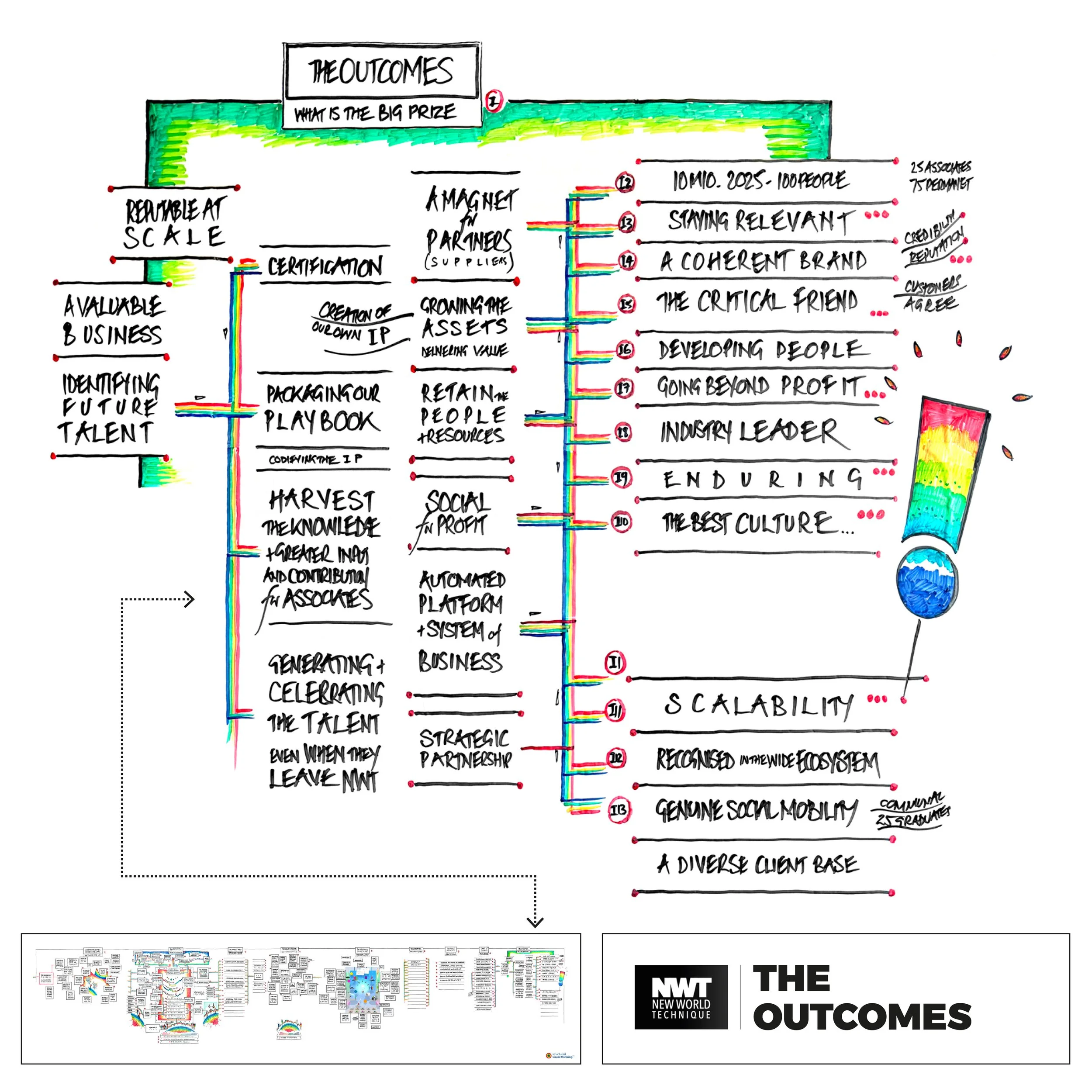
The Discussion That Followed
What are we starting to observe that signifies progess. What effects and signs should we be looking for that prove that our plans to achieve the outcomes are indeed starting to work?
New clients are coming to us - that we didn’t already have a relationship with
We are selling more to existing customers, expanding the scope they will give to us.
We are getting more warm leads through different channels
We are attracting and retaining the talent we want - they have heard of us before we even approach them
There is interest in us as a business - M&A signals
There is no shortage of partner opportunities/referrals
We are building teams of practice - across capability - that we can put into projects. We have grown expertise in critical areas
We are growing but still retaining our core qualities - still connecting, communicating, and collaborating. We haven’t lost our identity
People leaving NWT are moving on to great new careers and jobs
Our clients describe us in the way we want to be known
More Service Now and Atlassian badges
A growing story of successful implementations
We are getting valuable customer testimonials that we can use for future business development.
Our graduates are deployable - we are increasing our capability
We have billable resources from social mobility backgrounds
We see discussions in communities we touch related to our commitment (mainly via the Change Foundation initially). We are a community and are reaching out to other communities we are drawn to.
We are being approached for our points of view (e.g. via the Media)
Everyone can give the same elevator pitch about NWT
Someone other than Glenn is the best salesman for a quarter
We have won a new bid or been added to a framework - without Glenn
MODULE S - The STRATEGIC SYSTEM Blueprint (Our IP)
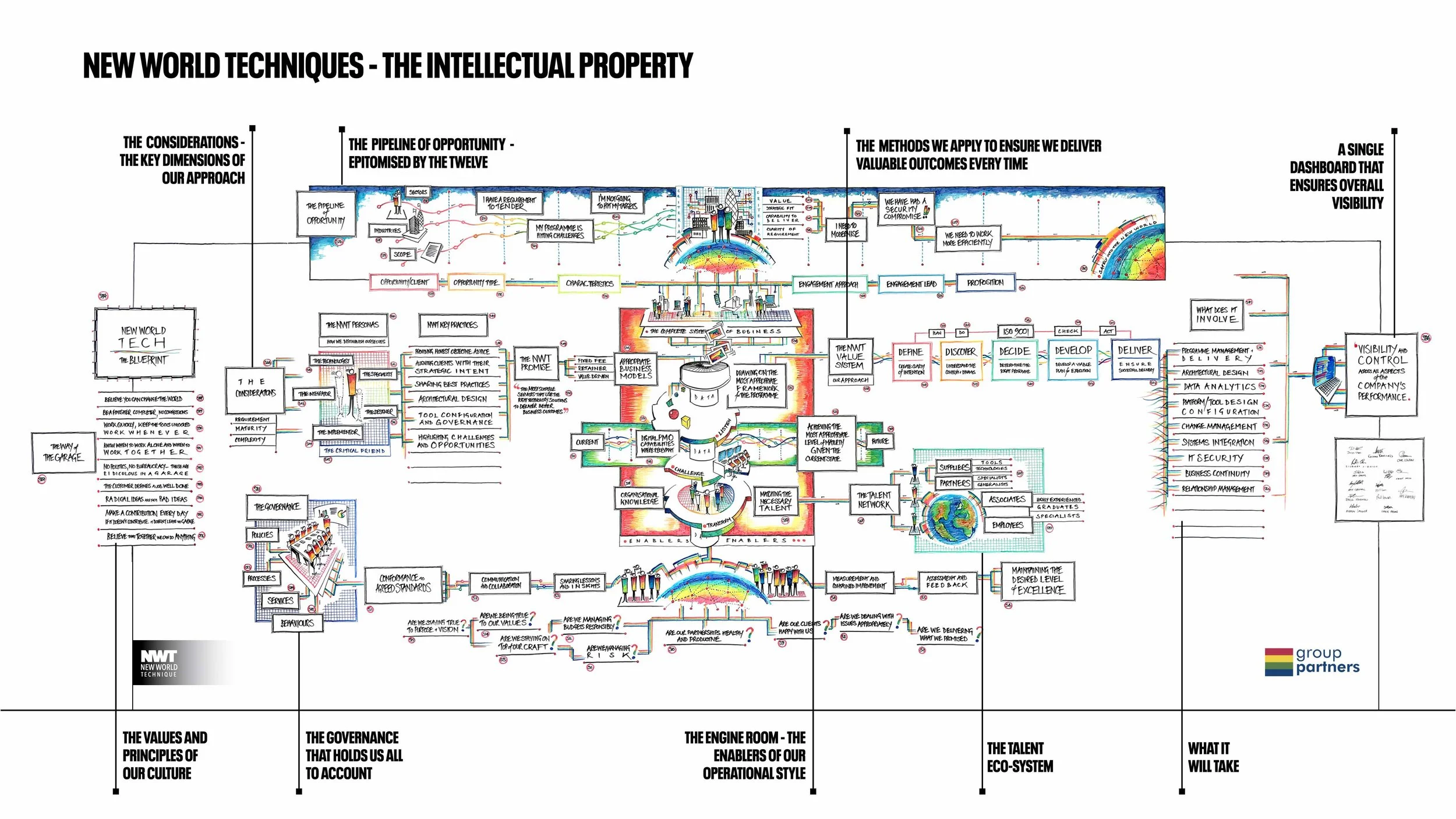
SPOKEN AUDIO IN SUPPORT OF THE VISUAL STORY ABOVE:
MODULE B - Our Vision
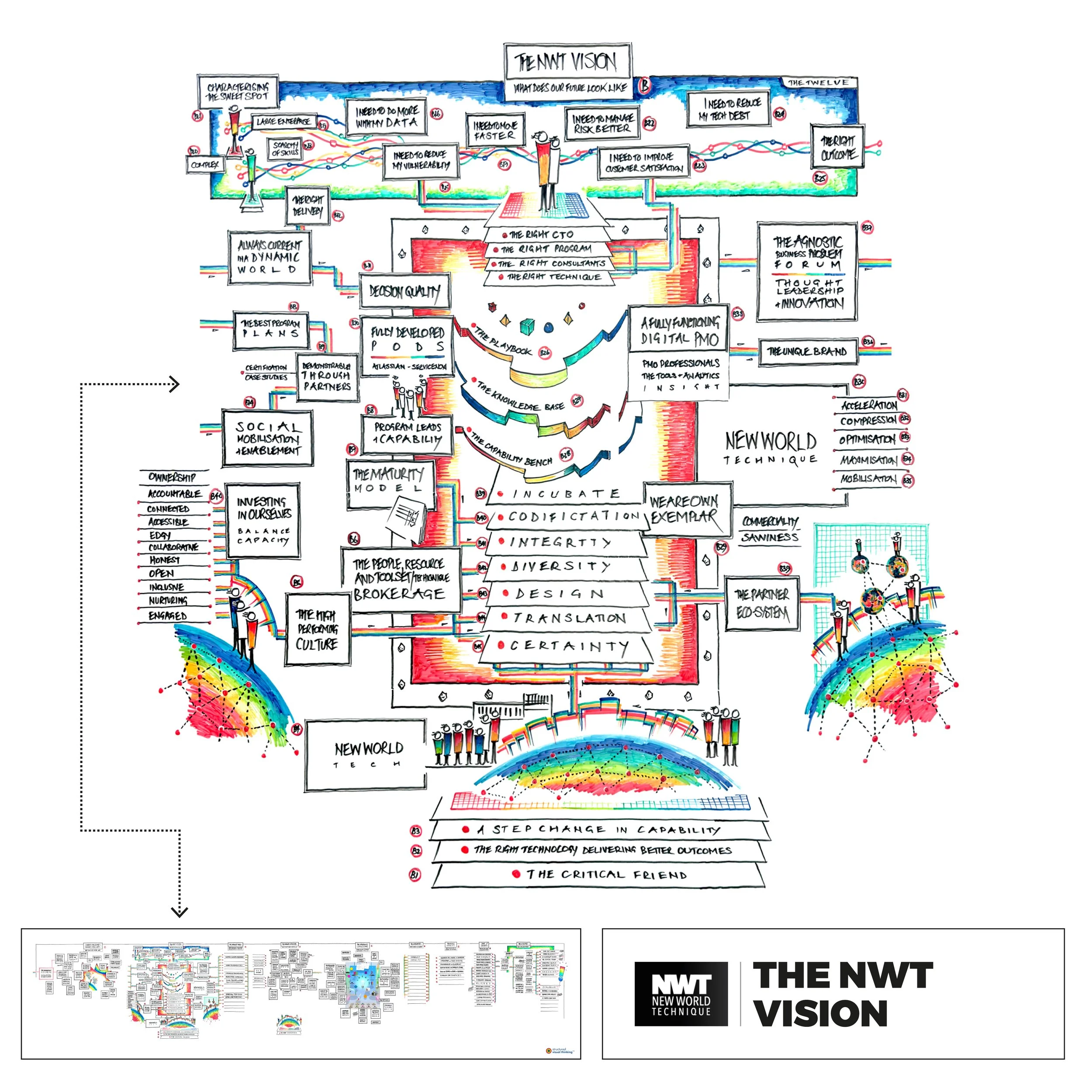
SPOKEN AUDIO IN SUPPORT OF THE VISUAL STORY ABOVE:
The Discussion That Followed
We answered the question that began with - “We see a world where..?” This is our North Star - our future story that could be told in infinite ways to different stakeholders.
Our vision assumes that the operational aspect (our busy duck) is represented by the blueprint above.
Think of the cogs in the representation below as where you would metaphorically double-click to examine the depth and detail of how we operate—our IP - our method, and our operational direction.
We see a world where…
All major IT work programmes have a fully functional digital PMO* - a team of professionals underpinned by toolsets, automation and analytics that harvest the data of the programme and enable the creation of meaningful reports on the state of the programme. The PMO is fully empowered in real-time, actively involved in the running of the programme, and providing genuine insight that leads to appropriate action.
*Accepting that there was further debate about what this means and how we position it.
We have fully developed deployable practice areas (Pods) of capability across our portfolio—capable teams aligned with the business need. We have a good range of resources with these skills that we can call on. We can mobilise the best resources for the job and demonstrate strength through our partnerships and the accreditation of individuals backed up by rich case studies.
It doesn’t matter what the requirement is - we have the right tools, plans and capabilities to respond to, and we can match the right pod to each client. Ready to deliver at the right time. We are building a portfolio of practice - a knowledge base that supports our playbook.
We are contracting intelligently - agreements that recognise variability and anticipate the challenges that can crop up and take account of them—ensuring that we are signing the right thing. We are commercially savvy and very sensitive to the need for regular, predictable cash flow.
We are creating a scalable platform - that will allow us to grow in whatever way we need. We have created a marketplace, a vibrant community of practitioners operating in multiple geographies. Building a rich knowledge base that is the envy of others.
We have codified how to crack the top ‘x’ problems and have become the one place to go in the market. Our ‘method’ for success is referenced as an indicator of a project's likelihood of a positive outcome. We always know what those ‘x’ problems are and have the techniques to move to solutions rapidly and more coherently.
Our method is supported by our maturity model that our critical friends run to quickly baseline a client’s current reality and identify what is needed to help them achieve their goals rapidly.
There is a hands-on/hands-off element. The hands-off part includes training programmes that we can offer to clients when they want to take on the programme themselves.
We are New World Tech - We stand for quality over quantity. We are the people who automate programmes and projects to derive business value. We are ‘big programme’ people, and we make big programmes successful. We have worked hard to codify what it takes to deliver the outcomes needed.
We are experts in: Configuration - Mobilisation - Risk Management - Decision Making.
We are straight talkers - we keep things simple, meaningful and relevant. We consider the questions businesses are asking, ask the right questions and offer the best guidance and opinion. Based on collective intelligence. We have the right connections and the right people.
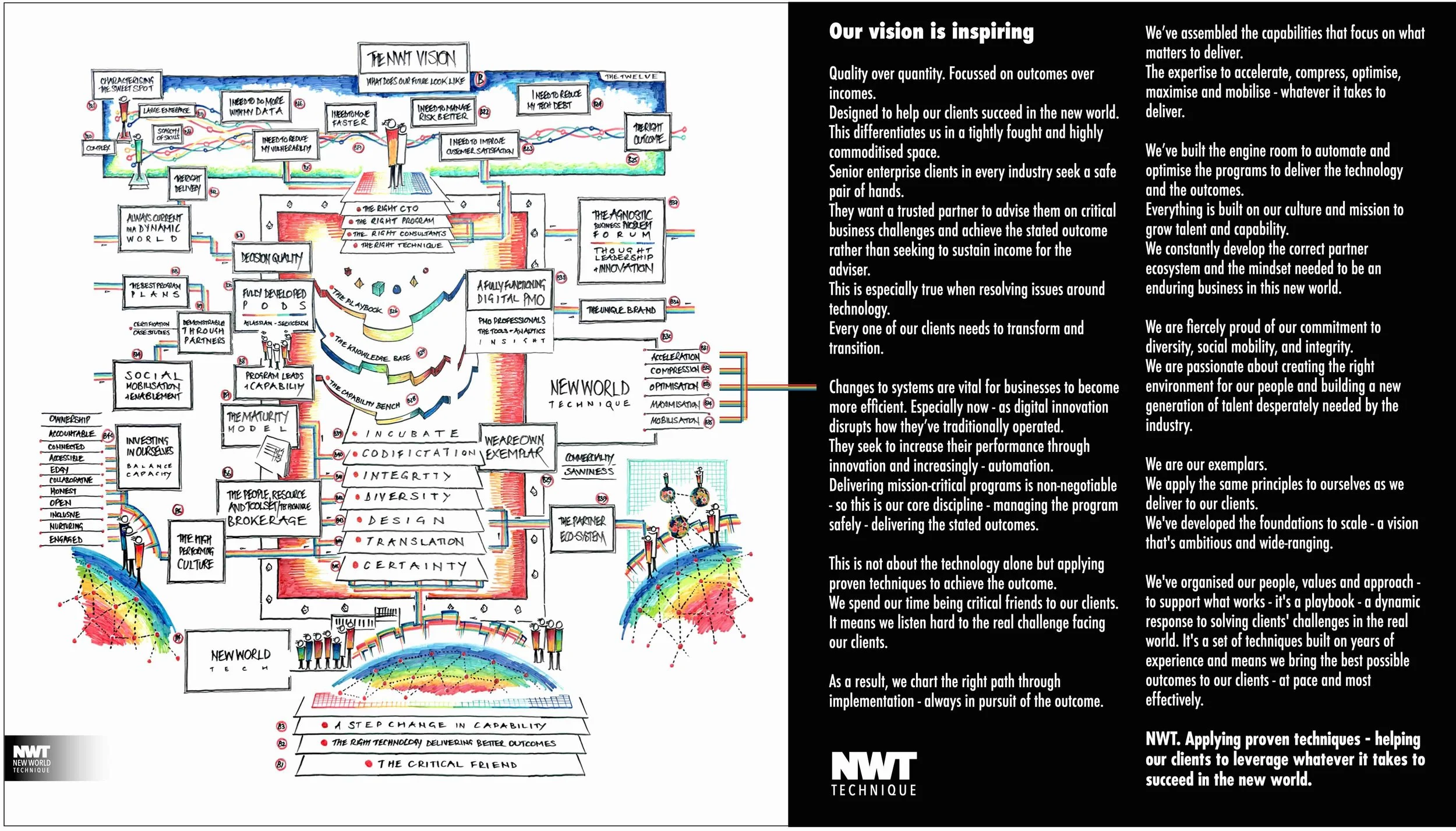
We are solving some of the new world problems that are facing clients today. Solutions that offer meaningful answers to very real challenges. Making new models possible shows clients how to realise their goals in a changing world.
We are a rich mix of talent essential for the creative process. Highly inclusive so that we are embracing diversity
Our Culture - Highly collaborative, edgy, honest, transparent, and determined. A fail-fast philosophy is fine - not putting your hand up to mistakes is not. We learn from our mistakes and don’t repeat them. We share experiences so that it’s easy to build on others' lessons.
We have clear roles and responsibilities with clear accountabilities. Anybody can give feedback to anyone; mentors are valued by everyone. It’s ok to say we need help, and we expect to be helped by our colleagues when needed.
We give real attention to onboarding and developing recruits. And it’s easy to find out who has done things before that might be relevant to new projects.
Meetings create real connections, even when virtual. We operate a ‘video on’ policy to check in with each other and ensure we are all engaging.
Knowledge sharing is treated as critical - not nice to have. Our knowledge and insight is a big part of what will differentiate us.
We treat capacity and commitment thoughtfully - balancing billable hours with other non-billable work. This means we have to build in the ability to establish this balance consciously. That may mean delegating more, automating activities, better decision making and empowerment.
We take Integrity seriously, and this can’t be taken too lightly. Some of the key relationships we have enjoyed so far are built on clients' trust in the integrity of key people (Glen). This has to exist everywhere. To be a critical friend demands the highest level of integrity - and has to be proven before others will gain the level of trust that Glen has earned.
Staying in touch with the trends - anticipating where the puck is going. It’s the business problems that we want to stay in touch with - so that we are ready with solutions and points of view. We encourage coaching from across our network to keep thinking about what matters and make sure we are thinking critically and broadly - constantly pushing ourselves to create insight.
We are hosting discussion forums to help us to stay current - to show thought leadership.
Separately we will be maintaining our register of what works, what doesn’t, and what we are seeing and experiencing—making a virtue of our objectivity. We are doing this to be ready with solutions to the latest business issues as quickly as possible. In some cases, we are bringing in thought leadership that avoids problems. In some cases, we are bringing in our innovation.
Not forgetting social mobility - we are embracing socially disadvantaged young people into our community and creating new opportunities for them that have the potential to change their lives for the better.
Stakeholder Perspectives

NWT has reached a crucial stage, has won some critical projects and now needs to decide what it wants to be known for - and in a way that doesn’t look dated in a year. Ours is an industry fixated on terminology, and the next big thing will throw out a new set.
And this jargon will drive clients buying behaviours. Wherever we place bets, it has to reflect where the industry is going.
Don’t try and boil the ocean, be more focused than you might want. And what we are saying in our vision has to be different - it might come across as another Accenture right now. It may be that we do what others simply say they do. Never underestimate the value of agility for large enterprises.
There is a real shortage of good programme leads and approaches to delivering complex programmes - the need is not going away.
Be clear about how you will be making money. Most Tier 1 providers have been riding the waves for many years. Yes, consider business outcomes but be very sure where to place bets. Service Now offers a tremendous opportunity - that doesn’t feel like a wave coming to an end any time soon.
Being able to help organisations with tools like this and also to help build the capability within that organisation - is a significant value proposition. The answer is not to be a service now body shopper - but remember, big money is rolling our significant programmes.
On acquisition - once you know what you are aiming for, you will have a better idea of how to get there. There is a strong case for organic growth unless the quick scale is the only option. A well thought / viable resource plan will help with the organic approach. Acquisitions can be a massive distraction.
Be your critical friend - make sure you have something NWT, that we are not kidding ourselves, that this differentiates us, and that we genuinely believe that.

What happens after these days? We have all been in a situation where we had great sessions, and then life simply returned to the status quo.
What we value is the individual expertise that we can connect with. People with skills, experience and expertise can drop into given situations. The challenge is here that we always need stellar, and we believe we can get that from NWT. So it mustn’t get lost - capacity is critical but not at the cost of high quality. With that comes agility. There has to be a shift to being outcomes focused - to avoid being simply a high-cost body shop.
Having NWT-specific collateral is essential and will position NWT as having valuable IP that everyone can speak about - it becomes a fantastic sales tool. From this, different propositions can be shaped. There will always be a quality step - it won’t matter who is put into the project. The value has to be in the hard to find difficult areas - not a commodity.
Most organisations struggle to connect their contracts and the solutions being put forward to the real risks and issues and ensure that they don’t get into trouble. Having real quality people with the skill sets and tools to highlight the focus areas and suggest solutions would be welcomed.
Regarding the acquisition, we value what the company brings - the value. Knowing that, in many cases, incumbents often leave after an acquisition.
Starting with the associate model made sense, but now it’s evolving as capability is developed. Someone has to own the development of this vision/strategy - it has to be someone’s job.
New World means future-proof, not tied to any specific tech that will become outdated. It is forward-looking, and that is what matters. It assumes we will be ready with answers when the time comes, and our clients need solutions.
For any deal we have done, when it comes to the company we worked with - there is always a ‘why’.
Hopefully, everyone here has a why. There is a clear reason why I go to Glen and NWT. You make me feel safe; it’s a visceral feeling. That feeling of safety meant I empowered NWT to take that job on. In the future, I want to move from safety to optimism!
Rolf Botha - HMRC
Without the arrival of NWT at short notice, we would not have made the transition, and the consequences of failure would have impacted the most vulnerable of people.
With the commitment and culture of the team and the years of experience in knowing what can go wrong - the team can be trusted.
The question is, what is the actual IP? Directionally where NWT is going will create value for clients - you are identifying the issues we live with.
Chris Abbott - 6 Degrees and Darren Ham Telefonica

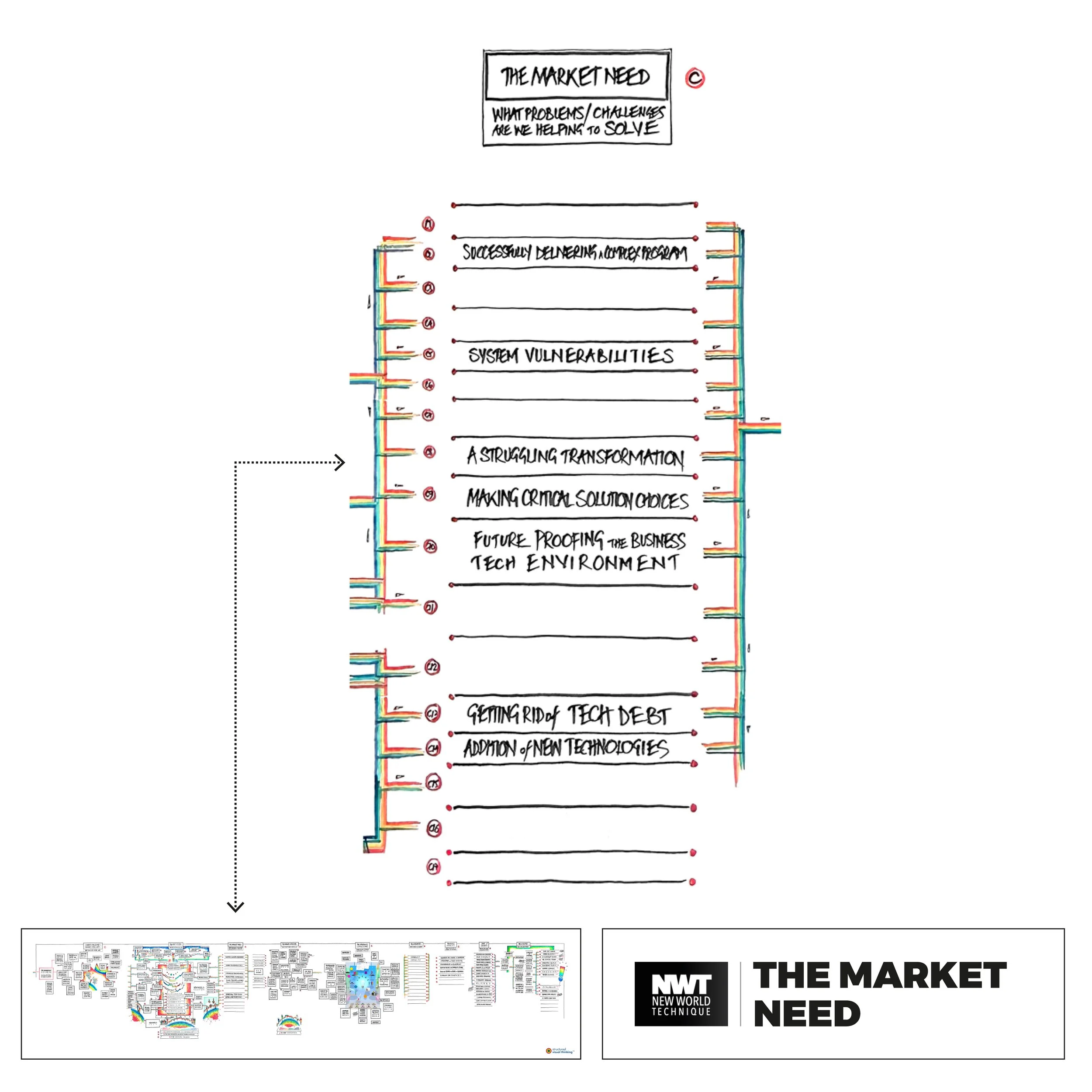
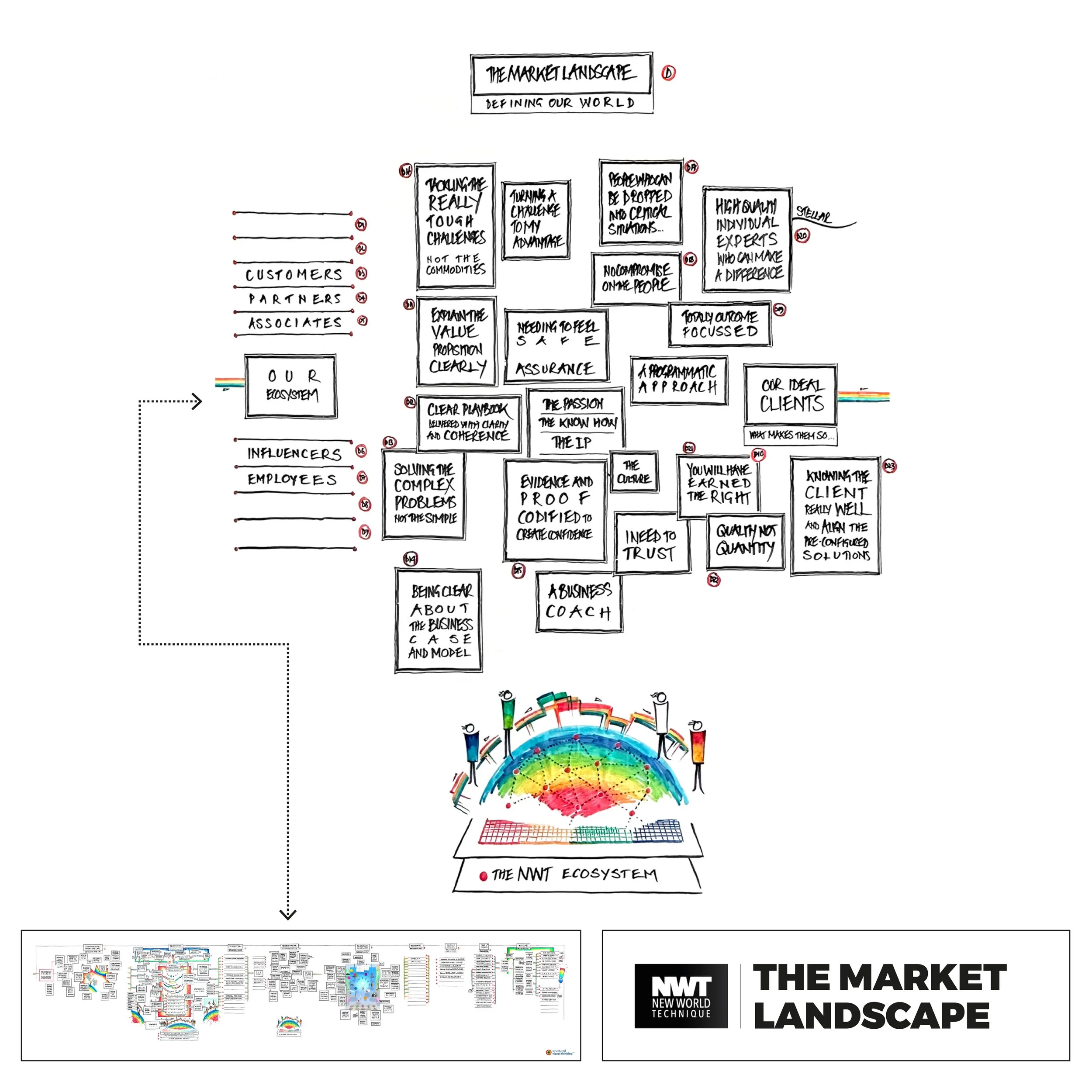
Module C/D - Our Marketplace
The Discussion That Followed
What do we need to know about our ideal clients and the market thats driving them. By underatding them and the insights in their minds we can create far more valuable solutions and help them to achieve the best outcomes.
We should not be bound by the current geographic landscape that we are working in. Our clients are not based in the UK alone. And in the future, there’s nothing to stop us from operating anywhere,
The topic of procurement is a challenging one. Large organisations, especially the public sector, struggle to shape a clear requirement as they tend to leapfrog the problem statement and jump straight to a perceived requirement.
This is all driven by the need for certainty - to be seen to be managing costs and applying the right level of diligence. The opportunity for us is to make it easier to buy services based on outcomes, not requirements that could constrain creativity and solve the wrong problem.
MODULE E - The Future Opportunities
The Discussion That Followed
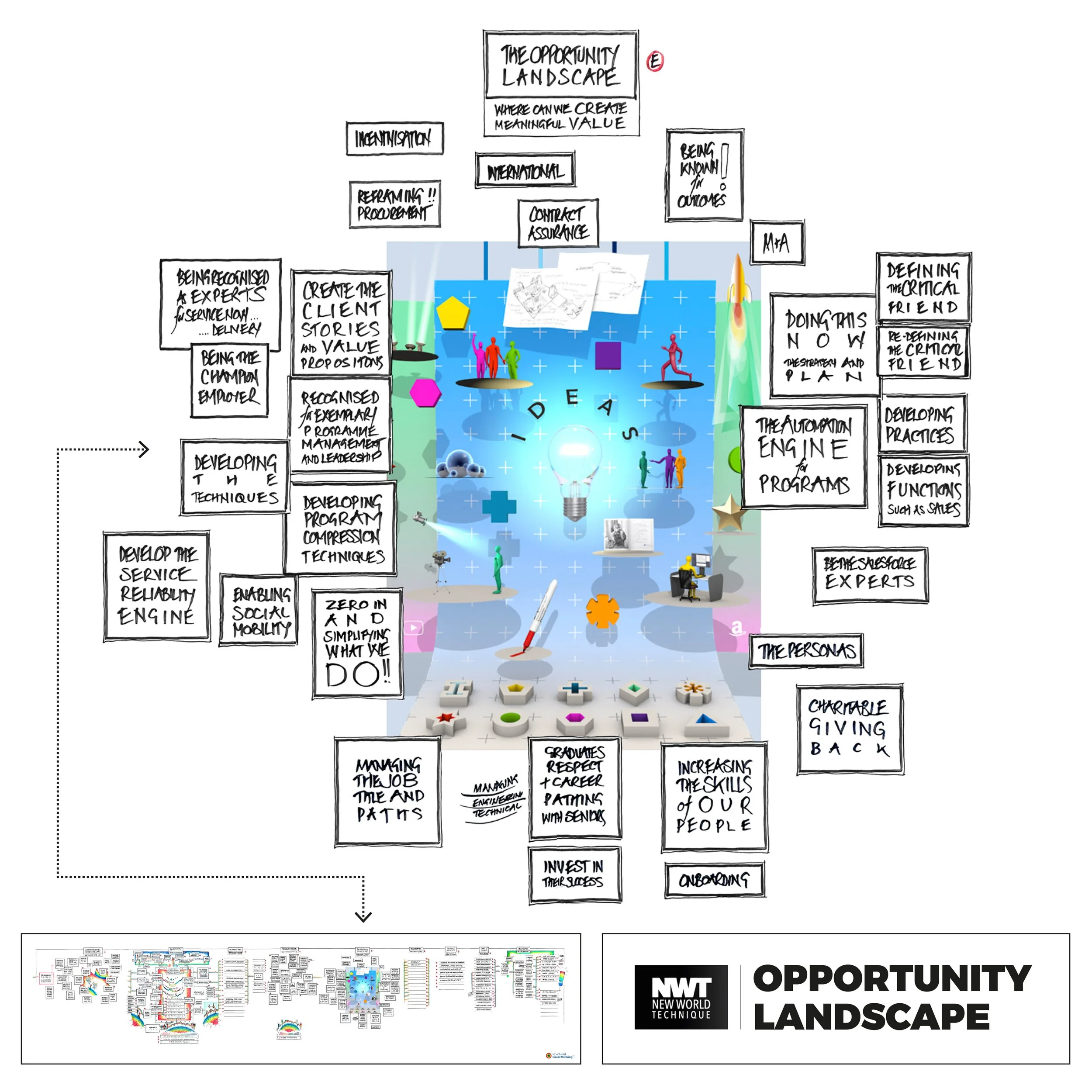
Where can we add value and create opportunities as we seek to achieve those outcomes.
Early contract assurance - independent scrutiny of contracts to help clients avoid making the mistakes that so often occur. This is something that we could do today.
Setting and managing expectations - especially with the associate network - those who don’t have the same feedback loops and reviews or the same controls.
Decision discipline - choosing to do something and sticking to it
Communication needs to improve - as we grow, this gets more challenging and has to be a bit more structured and layered.
Create a strong brand that becomes our differentiator in an industry hard to differentiate
The creation of Practices - like Service Now, for example. Aligning Pods to capabilities. This can include business functions like Sales as well - it creates focus and cross-skill working. Another example is Microsoft Dynamics (ERP). And not forgetting what we already have strength in - like programme management, for example. We can focus now on what we are good at rather than trying to be all things to all people.
We can still position ourselves as the ‘Automation Engine’ for the governance of programmes that leads to better management of programmes. Especially for transition and migration programmes where we have real strength. Arming teams with higher-quality information about their programmes enables better decision-making and management.
We are about to start scaling dramatically, so the timing to address these things is an opportunity. It will get much harder to put all this in place when we are double the size. Now is the time to create solid foundations and put this vision and blueprint into practice so that it becomes fully embedded.
Establish a Service Reliability Engineering ‘engine’. There are a lot of organisations tackling issues without really understanding the reasons for their problems; they are essentially just focused on closing down tickets.
Leveraging external capabilities more effectively - the build vs buy decision. There will be areas of specialism where we need skills that we are not developing internally - or are not fully mature yet.
Maximising skills and career opportunities: Creating more exposure to real-life situations that gain valuable experience or graduates. We have to make graduates billable - it is a condition of some contracts. But we have to set them up for success and not for failure. And set clear expectations with clients.
We are already planning the graduate journey - for three months, they will spend time with business functions and start their Service Now training. Then a constant feedback loop between mentors and graduates to help shape the right career. During this, we will identify the tech skills that each person possesses. Moving on, they will start to drop into client situations. A 6-month timeframe. There is an opportunity to continue this beyond grads - returners to work, for example.
We need to ensure we invest considerable energy in people's career paths and help everyone to develop to their full potential. And having clear roles defined that align with career paths in support of our personas.
The social element - if we partner with large companies, we will need a social value proposition; it’s not just a ‘nice to have’. We need to be able to give something back to society - maybe starting small and growing.
Module A - Our Challenges
The Discussion That Followed
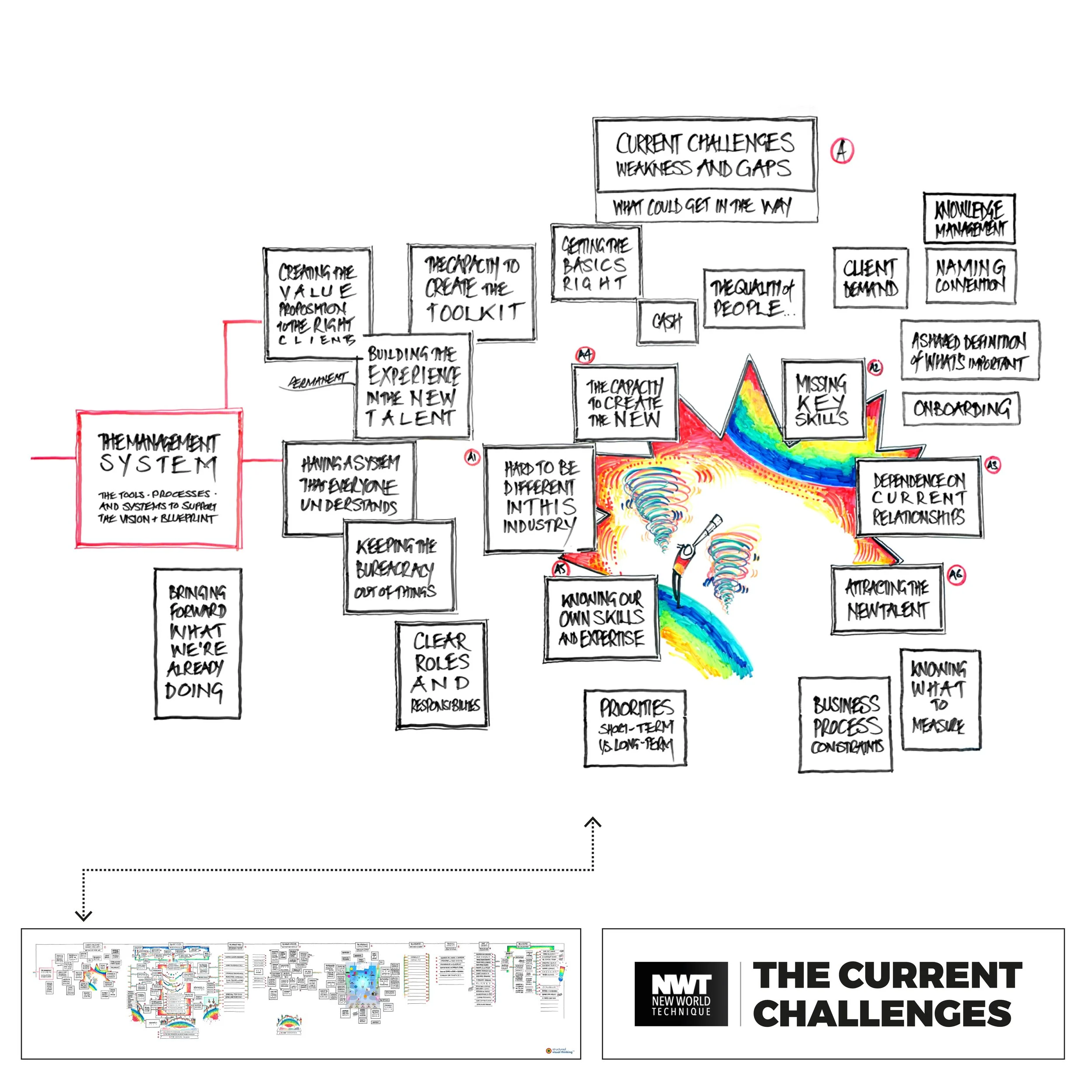
What is going to get in our way of achieving our vision?
The quality of people so that we can scale our model
Cash - not enough to invest in creating our playbook and IP
Client demand
The capacity to create the toolkit/blueprint - balancing the tension of short - long term
Building the level of experience needed to offer clients - in permanent staff
The need to know - having a solid system that everyone understands without creating bureaucracy or everyone feels they need to know everything - what is enough?
A shared definition of what’s important - we have a green dashboard, yet Glen feels it is red.
We have grown fast and need to plug specific gaps - like clear roles and responsibilities and what we need to measure.
We need more structure to our knowledge base - there is a lot of stuff flying around, and we need to get more standardisation, organisation and management into it. We are aware of things we have, but we don’t all know where it is, and it may be in the format we need for repeatability.
And we don’t necessarily know what we all know - so we are missing valuable insight and risking repeating past mistakes and not benefiting from others' learning. We already have the action to do this - we just need to make sure that it is aligned with this vision and blueprint.
And that we sustain this - we have good processes, but they are not followed - the suggestion is capacity - it’s easy to put them low down on the list. Until recently, many people simply don’t know where things are and therefore, it's easy not to follow the process.
Onboarding on essential things like naming conventions is not always happening - always it's down to busy people not making time for this - and not appreciating why it’s essential. Our management system is being developed and will serve us, but it’s not mature yet - and we haven’t communicated it as a result.
Is the 5D framework approach fully defined? There is a sense that some aspects are clear, but not all. This is a critical part of the blueprint.
We sometimes find ourselves doing client work that is not necessarily aligned with our skill sets or our core proposition. We are simply plugging gaps for them because it brings in revenue. It does help build relationships and open up potential leads, but it won’t necessarily help us to further our vision - we are not creating new assets that we can harvest.
We sometimes create what feels like powerful proposals, but the client can’t consume them.
Module G - Priorities for Focus
TEAM FEEDBACK - FOCUS
Team 1.
Five priority actions (no dates yet) in order:
Knowledge and Sales are the main two. Harvest the knowledge, create knowledge and then share and manage. A project closure piece where new knowledge is created. Supporting processes to organise, define, tag etc. to make sure that knowledge is easily found and leveraged.
The pipeline increase - a sales plan to get to £10m. Identifying a good mix of sales - new business vs existing. Including a segmentation of the leads and having a ‘system’ for qualifying them. (A Waitrose-style partnership). There is an element of marketing attached to this, presumably - the plan is aligned to the lead generation channels, but there will need to be an effort to reach audiences with the right messages.
Update sales and marketing and onboarding - capturing all of this goodness and aligning on our core offerings. Updating our external and internal facing material - ready to align everyone to the blueprint that we have created.
Creating a coherent brand. Update the target operating model - clarifying and strengthening. Roles and responsibilities - and a design that has scale in mind. Defining the capabilities we have and those we need to acquire/develop.
Partnerships - the agreement with SERVICE NOW is close, and we are pouting a lot of things in place to be ready to grow this opportunity. This is about building the practice, strengthening the bench and being able to promote this as a service we can deliver. Our differentiation has to be how we frame the proposition - not simply about the tech, but more about what it takes to make it work—deep rich business process knowledge. (Nick - pick the bets, which modules - business processes).
Team 2.
There is a sense of sequence here, although some are in parallel.
Fix the management system and establish structure - build the machine. Create the capacity and equip the people - the delivery capability. While still feeding the beast.
Nail the pitch - a consistent narrative about who we are and what we do.
Build the IP - set an ambition; we can’t do everything so three areas - prove the maturity model for some of the 12,
Deliver the SNOW (Service Now) capability,
Nail the career paths for the personas - and align the people to the 12 - map the skills and define the teams. Be able to instantly interrogate a warm lead and have the recipe for how we’d respond.
Stop Glenn selling - not immediately, but we need a plan for slowly moving him away from certain sales.
Enter/Win an award - by harvesting the stuff we have done already. Get recognition. Treat it like a bid.
Deploy the CSAT and act on the insight/feedback - we have built this as a basic structure - it just needs to be delivered.
Design a growth roadmap - one that takes account of risks and challenges, and factors in capability development in parallel. This does not consider M&A; it’s purely organic.
Build on our solid commitment to social value - partner for a charitable contribution like the Prince’s Trust.
Start establishing the playbooks - for example, building solid leads and converting them. Extending this to the 12 business problems.
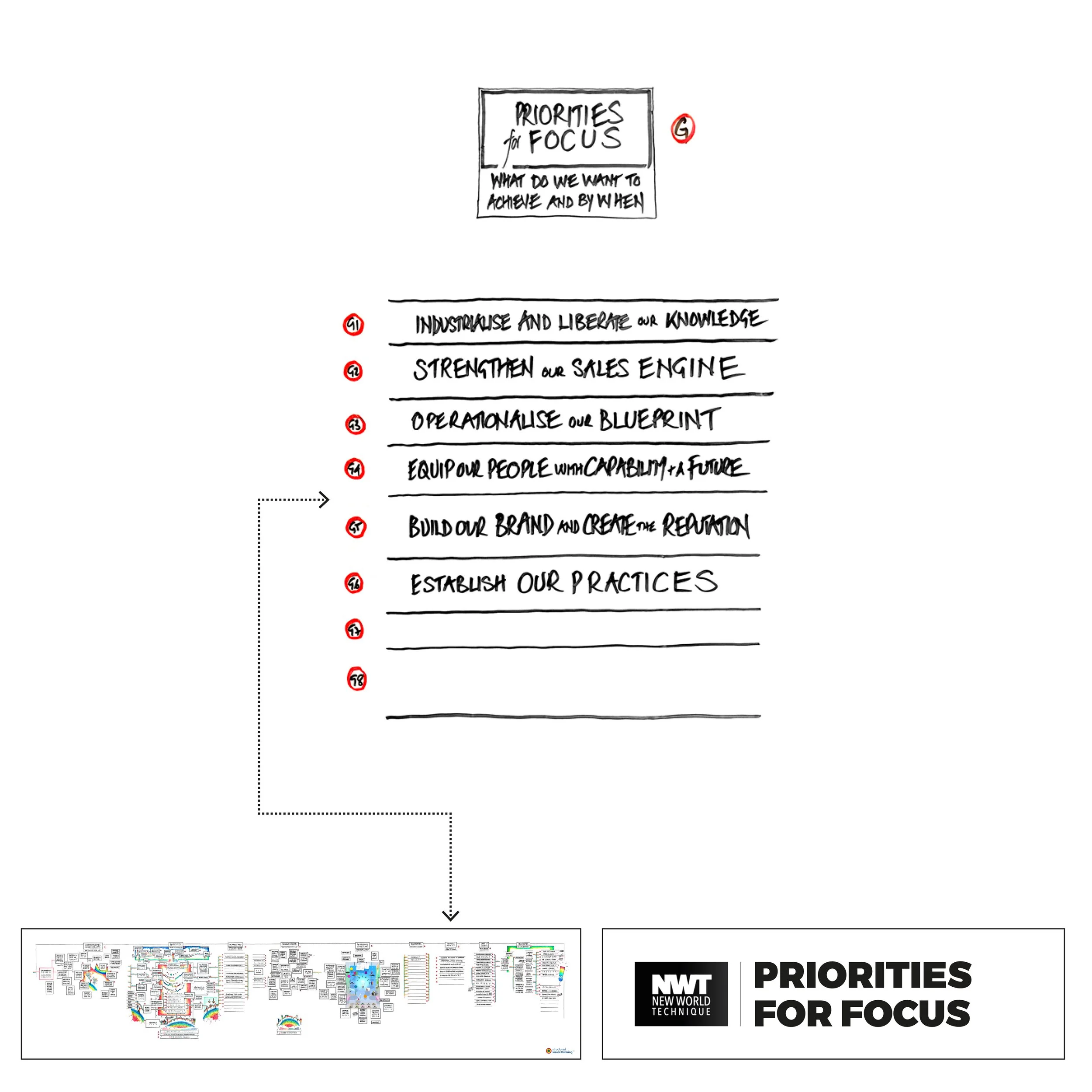
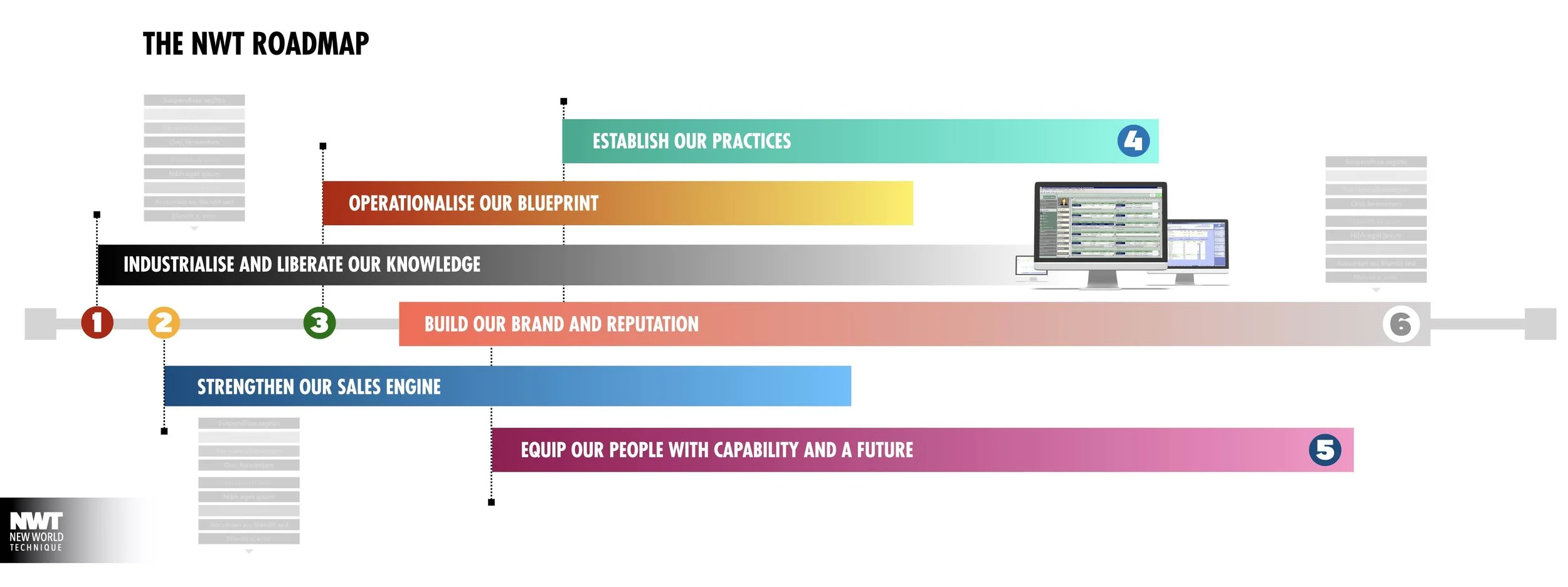
We compressed the teams' thoughts into six clear themes to take forward:
Summing Up
We are all at the start of a new journey.
Each one of us is at a different stage. Each of us contributes value in a variety of essential ways. It doesn’t matter where we work in the business, just that we are a part of this, entirely centred as a team.
Our customers have validated what we have been thinking, and it is now up to us to own this. We all signed up for the exciting ride!
Our Strategic Journey
The frameworks we went through have given us the foundations for our strategy. In NWT terms, we have undergone a phase of Discovery and started to Define the opportunity that needs to be Delivered.
We are now at the first step of how and what to Decide upon.
A strategy is all about choice -
a set of interrelated choices that positions the organisation to win.
OUR END IN MIND - We’ve identified our outcomes - we ranked some of them - this defines what the strategy must achieve.
ADDITIONAL VALUE OPTIONS - We’ve developed many possible opportunities in the context of these objectives. We must choose what opportunities we should choose to achieve the outcomes.
OUR VISION - We have a North Star - a vision that defines what winning means to our clients.
MARKET RELEVANCE - We’ve agreed on the key reasons why we would get contracted by our clients.
WHAT MAKES US UNIQUE - We’ve started to develop the operational framework - the blueprint that tells us how we need to organise ourselves to win.
WHAT WILL GET IN THE WAY - We’ve identified the barriers and challenges we must watch out for and resolve. We can turn these challenges to our advantage.
OUR FIRST PLAN - We’ve established the priority focus areas. These are the foundations for the plan that must be detailed further with projects, owners and timelines, budgets and implications across the business.
We now need to industrialise and operationalise.
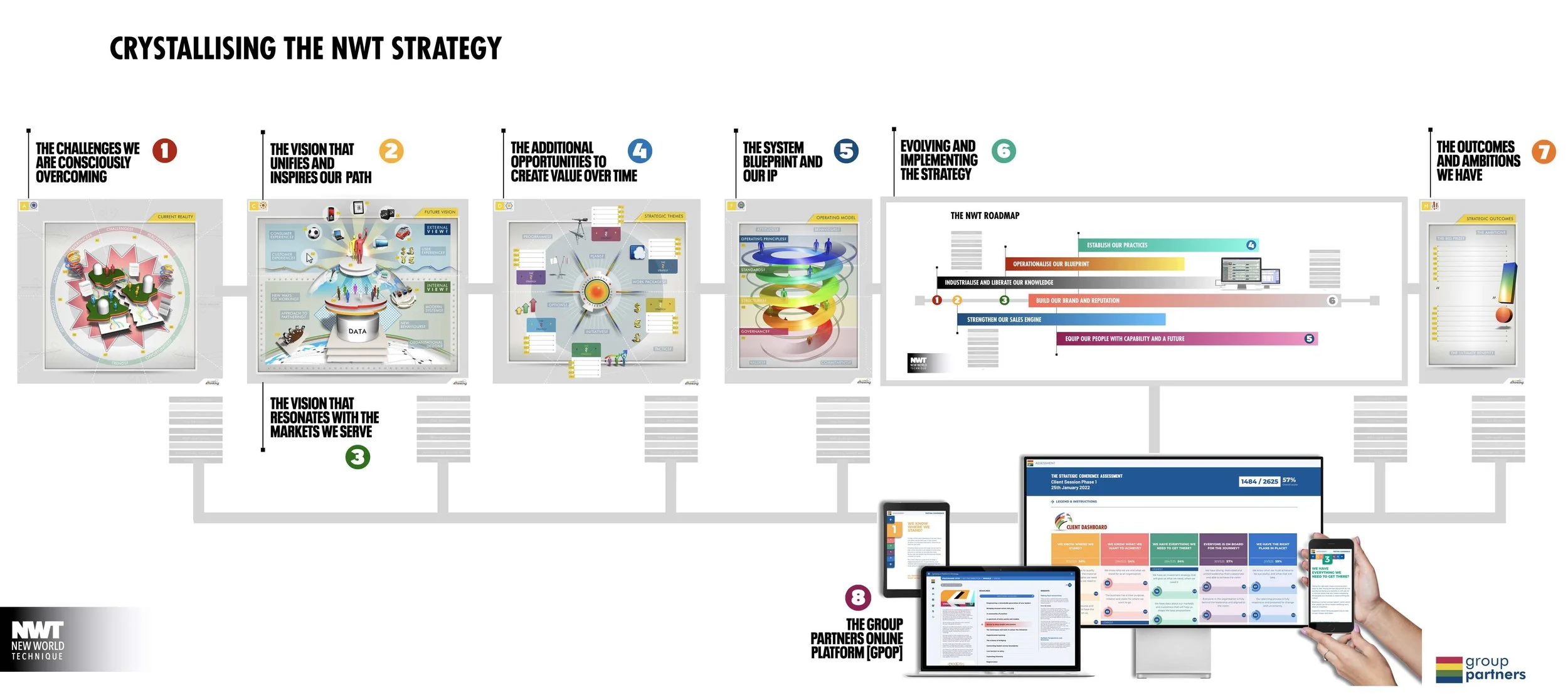
Making A Plan Work
NWT knows better than most how to execute a viable plan.
We closed the session with the following immediate actions for the team to pick up:
Drill into what sits behind the six primary themes we’ve established- start to shape the projects / initiatives.
Checking for gaps, getting a real sense of the scope and scale of the work and defining each project - so that a proper plan can be laid out.
Defining these more meaningfully isn’t a trivial task, so we expect this to take a few days/weeks. It’s critically important as they represent activities designed to deliver the outcomes.
We are happy to review these materials and offer objective reflection, and will stand by ready to engage as appropriate.
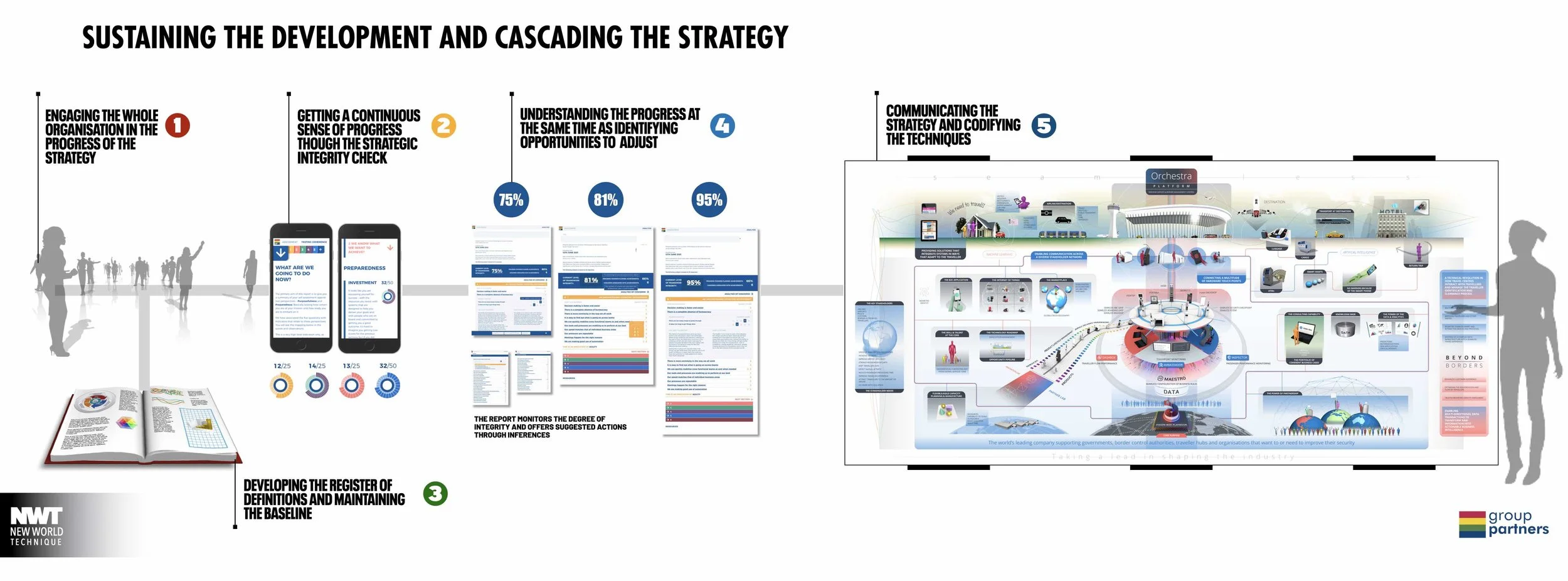
Beyond this:
We might then suggest completing the framework outputs digitally. Blueprint, Vision, Roadmap - (You can see examples of these above)
We would aim to be around to maintain alignment. (See assessments below)
We would discuss material artefacts that help to cascade the strategy and plan accordingly.
We would design all this material to be helpful as sales collateral and marketing materials additionally.
These would become core materials - tools for internal and external use, sales tools and general marketing.
To sustain the development, we also suggest testing two foundational things:
A sequence of regular assessments designed to ensure the long-term integrity of the above
Implement the Group Partners Online Platform (GPOP), enabling the team to stay connected and update the frameworks over time.
There’s also a case for a 6-month health check where the team regroups to determine progress and course correction.
Thank You, and we look forward to next.